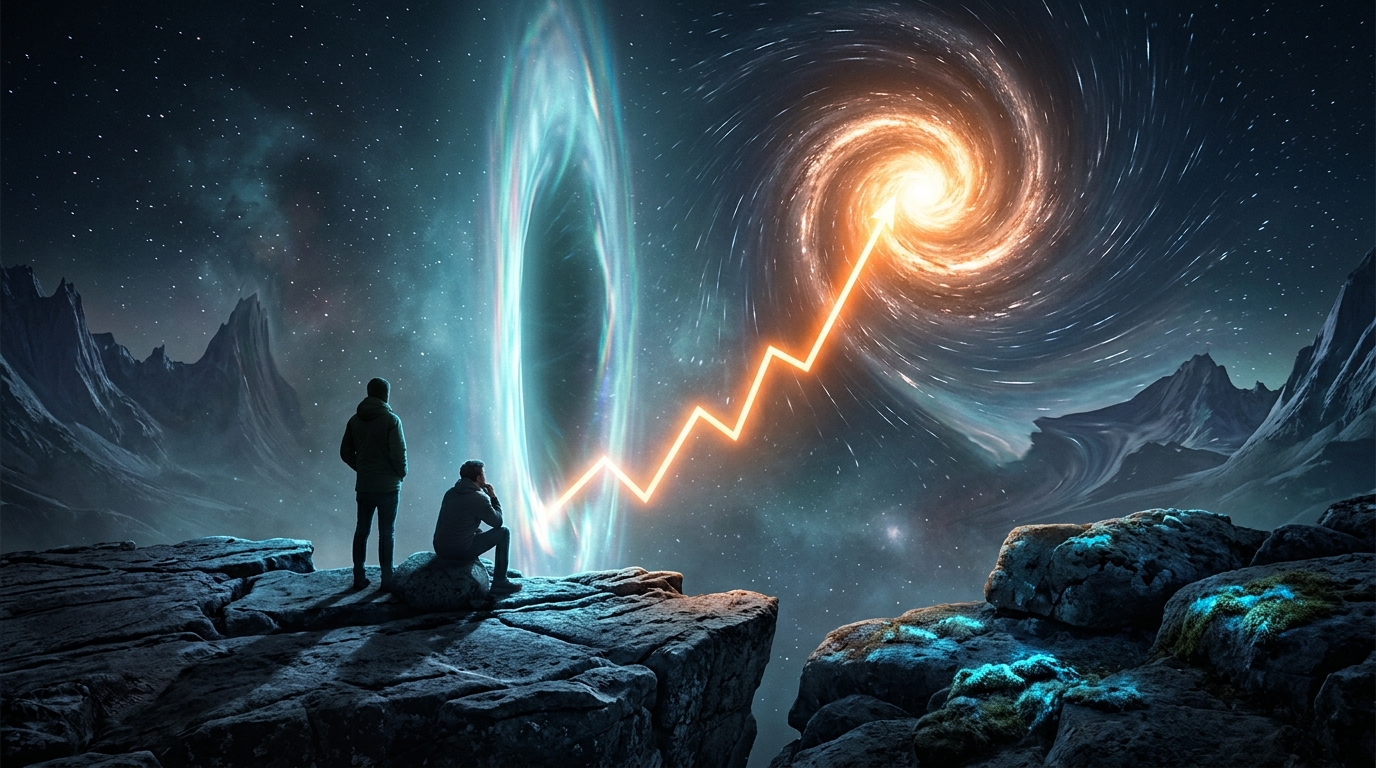
"We Are in the Singularity": Musk and Altman Agree — for the First Time — on a Diagnosis
Sam Altman (OpenAI) said it in a podcast. Elon Musk echoed it a few hours later on X: "2026 is the year of the Singularity." Demis Hassabis (Google DeepMind) talks about the "foothills of the Singularity." Jensen Huang (Nvidia) asserts: "I think we've reached AGI." What is the Singularity? Are we really in it?
On July 26, 2026, in an episode of the podcast Relentless, Sam Altman (CEO of OpenAI) dropped this line: "I've been waiting for this my whole life, and I think it's going to be amazing, extremely positive, wonderful for the world." The "this"? The Singularity. According to Altman, we're in it.
A few hours later, on X, Elon Musk — who agrees with Altman on almost nothing since their fallout — publicly responds: "We are in the Singularity, just in its very early stages." Then, in a second post: "2026 is the year of the Singularity."
Two men who dislike each other, publicly disagreeing on almost every topic, have just converged on the strongest diagnosis possible regarding AI. And they are not alone: Demis Hassabis (Google DeepMind) mentions the "foothills of the Singularity." Jensen Huang (Nvidia) states bluntly: "I think we've reached AGI."
What exactly is the Singularity?
The concept comes from three authors:
- John von Neumann (1950s) first mentions a technological "singularity," a point beyond which human affairs can no longer continue as before.
- Vernor Vinge, computer scientist and science fiction writer, formalized the idea in 1993 in a cult essay: the Technological Singularity refers to the moment when AI surpasses human intelligence and becomes capable of self-improvement, triggering an exponential cycle of progress beyond human understanding.
- Ray Kurzweil, engineer at Google, popularized it in The Singularity Is Near (2005) and set a date: 2045. Kurzweil recently revised his prediction — the Singularity would arrive as early as 2029.
The traditionally associated characteristics:
- AI surpasses general human intelligence (AGI = Artificial General Intelligence)
- AI improves its own code (recursive self-improvement)
- The pace of progress becomes unpredictable for human observers
- Society shifts — economically, politically, existentially — into a regime we cannot anticipate or control
Von Neumann, 1958: "The accelerating progress of technology gives the appearance of approaching some essential singularity in the history of the species, beyond which human affairs as we know them could not continue."
Why Altman and Musk are saying it now
The 2026 context offers Altman and Musk several tangible signals they read as markers of the Singularity:
- ASTRA (OpenAI's next model) has just solved 10 open problems in mathematics, some of which had been stagnant for half a century.
- Models now produce code, formal proofs, and original scientific reasoning at a pace no human can individually keep up with.
- Self-improvement is already here on a small scale: Claude Code, Cursor, and others help AI engineers improve the next AI models. The recursive loop begins.
- Gains remain superlinear with each model generation — the wall predicted as "imminent" since GPT-4 has yet to materialize.
The dissenting camp: "no, not yet"
The majority of academic researchers and authors interviewed (notably by Business Insider) are much more cautious. Their arguments:
1. Current models still fail on basic reasoning
GPT-5, Claude Fable 5, Gemini 3 stumble on elementary logic puzzles that a child solves. They hallucinate with a confidence that betrays a lack of metacognitive understanding. A system that doesn't know what it doesn't know is not an AGI.
2. Recursive self-improvement is not yet real
Models help write other models, but they do not design their own architectures nor collect their own training data. The feedback loop is not closed.
3. Benchmark curves are slowing
On many academic benchmarks (MMLU, GPQA, HumanEval), gains diminish from one generation to the next — a sign that we are approaching ceilings, not an explosion.
4. Training costs are skyrocketing
Each new generation costs 10× more than the previous one. This progression is not economically sustainable — even less compatible with an intelligence explosion.
Gary Marcus, one of the most vocal critics, titled his analysis: "Sorry Sam and Elon, We Haven't Reached the Singularity." His central argument: calling "Singularity" what is actually a massive deployment of very useful but limited tools devalues the concept and distracts from real issues (bias, misinformation, economic concentration).
Why the word carries so much weight
That Musk and Altman agree on the Singularity now, in this specific context, has political implications:
- Regulation: the Singularity is used as an argument to justify the urgency — or futility — of AI regulation. "It's already too late, let's not slow down," on one side. "It's here, we must act immediately," on the other.
- Valuation: OpenAI is valued at 500 billion dollars, xAI (Musk) at 200 billion. Claiming the Singularity is underway supports stock prices.
- Narrative race: framing events as an "already started Singularity" legitimizes the frantic race between labs, including bypassing safeguards.
So, are we in the Singularity?
An honest reading: it all depends on the definition.
- If Singularity = "AI does things humans can no longer follow individually" → yes, clearly. A single researcher cannot keep up with ASTRA's scientific production pace.
- If Singularity = "AGI capable of recursive self-improvement and surpassing all experts on all tasks" → no, not yet. We're getting closer but we're not there.
- If Singularity = "unpredictable progress regime where society changes faster than it can adapt" → maybe. We already see upheavals (companies doubling via Stripe, disruption of the creative job market, challenging copyright laws).
The word "Singularity" — like the word "AGI" before it — becomes an ideological marker as much as a technical concept. Using it positions the speaker. Hearing it requires unpacking the underlying definition.
What is certain: we are experiencing a major transition. Whether it's THE Singularity in the sense of Vinge and Kurzweil, or just a prolonged plateau of upheavals, the question will remain open for several more years. One thing is clear: when Musk and Altman agree on something, it's usually because it suits them both. Their convergence should be read with this in mind.