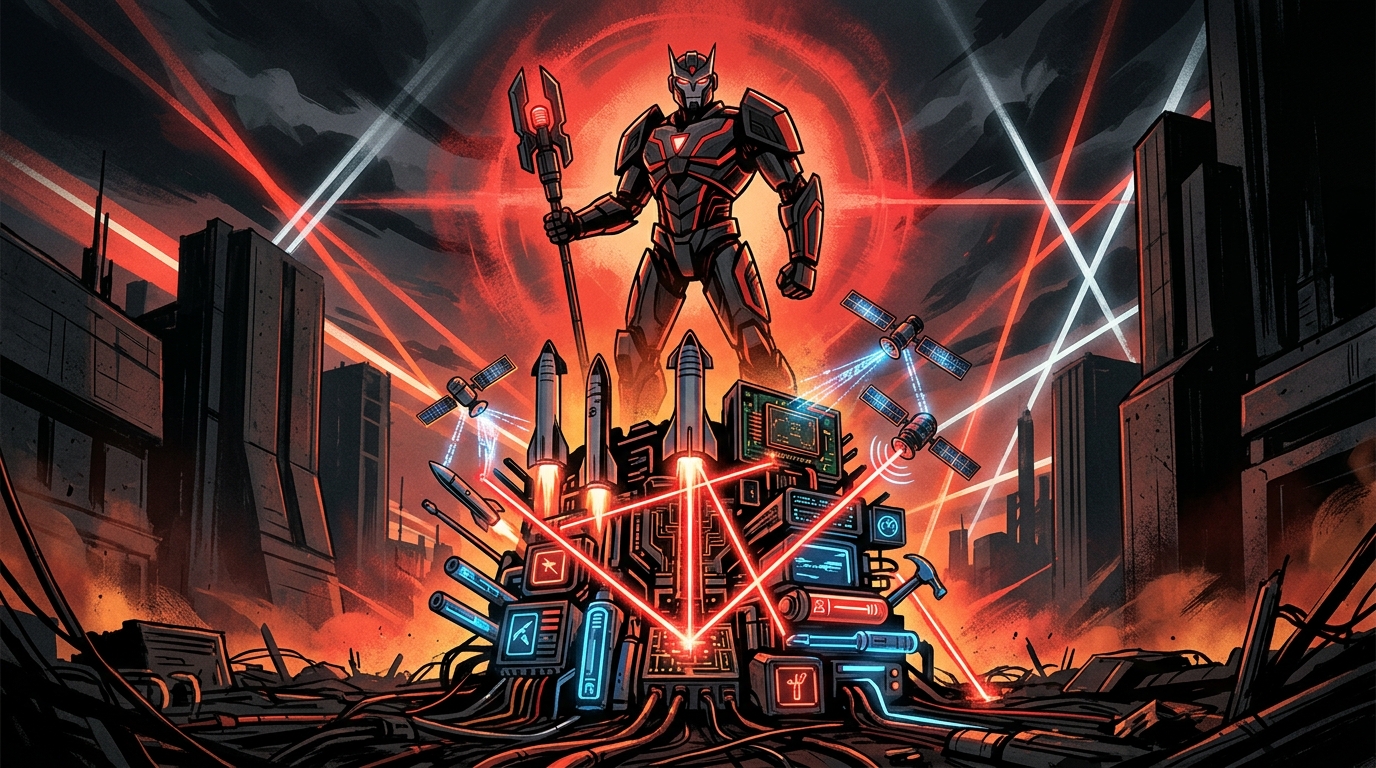
Grok Bot, Cursor Origin and Grok 4.6: xAI Stacks the Building Blocks of a Vertical AI Empire
In ten days, SpaceXAI launched Grok Bot (24/7 agents in Cursor), Grok 4.6 (500K context tokens), and integrated Cursor Origin into its ecosystem. With xAI absorption and Anysphere acquisition for $60 billion, Musk's vertical AI empire is taking shape. Analysis.
In ten days, SpaceXAI released three building blocks reshaping its developer offering: Grok Bot (a 24/7 autonomous agent distributed in Cursor, launched on August 11), Grok 4.6 (a new model with 500,000 context tokens, launched on August 12), and the integration of Cursor Origin — the new version of the proprietary Cursor IDE since SpaceX's acquisition of Anysphere for $60 billion. The strategy is clear: build a vertically integrated AI empire, from silicon to dev tools.
Grok Bot: the 24/7 agent in Cursor
Grok Bot marks SpaceXAI's entry into the race for “persistent agents”, a category where Gemini Spark, ChatGPT Operator, and Anthropic Computer Use are already competing. Specifics:
- Each Grok Bot has its own cloud computer (dedicated VM)
- It connects to tools already used by the user (Slack, Notion, GitHub, Linear…)
- It executes multi-step tasks 24/7 and only returns when human approval is needed
- Distributed directly in Cursor: a developer can invoke a Bot from their IDE
The beta is available for SuperGrok subscribers. A user quoted by ExplainX reported generating 74 video game assets in 2 hours with a single Bot.
Grok 4.6: the race for context
Released the next day, Grok 4.6 brings the following technical advancements:
- Context extended to 500,000 tokens (compared to 256K on Grok 4.5)
- Available immediately via the xAI API, Grok Build, Cursor, OpenRouter, Vercel, and Cloudflare
- Promotional pricing: 2× promo the first month to attract developers
On benchmarks displayed by xAI, Grok 4.6 claims to be “competitive with the best models” — the brand asserts parity with Sonnet 5 and a slight lag behind GPT-5.6 Sol and Opus 5. Independent reviewers (including Lenny's Newsletter) confirm: good model, not revolutionary, with blind spots on very abstract Python code and literary analysis.
Cursor Origin: the relationship becomes exclusive
Since the acquisition of Anysphere in June, Cursor has evolved. The new version — Cursor Origin — highlights Grok in the UI, positions Grok Bot as the “recommended agent mode”, and offers free “Grok credits” for Cursor Pro subscribers.
It's no longer an agnostic IDE. Cursor Origin is Grok's showcase tool, with prioritized access to xAI models and a commercial funnel towards SuperGrok.
Competing models (Claude, GPT-5.6, Gemini) remain technically available, but with less ease of invocation. Some developers on Reddit report that the routing defaults to Grok, boosting xAI's usage metrics.
The SpaceX + xAI + Cursor strategy: vertically integrated
Stack the blocks:
- Models: Grok 4.6 (today), Grok 5 (expected Q1 2027)
- Agents: Grok Bot
- IDE: Cursor Origin
- Compute: Colossus datacenter (Memphis) + upcoming, Starmind AI1 in orbit (Q4 2027)
- Network distribution: Starlink
- Chips: exclusive Nvidia partnership for orbital, massive GB200 purchase for Colossus
Neither OpenAI, Anthropic, nor Google DeepMind have this level of vertical integration. Meta approaches it via its MTIA chips + Llama + Ray-Ban Meta, but remains dependent on a third-party OS. Musk is building a closed empire.
What it's really worth
Independent reviewers (Lenny, ChatPRD, DataCamp) converge:
- Grok Bot is “impressive on paper, still rough in use”. The UX for resuming after an interruption is imperfect. Prices rise quickly if used seriously.
- Grok 4.6 is “a good model”, not a leader. It excels at medium-level coding tasks but lags behind Opus 5 in complex reasoning.
- Cursor Origin divides. Absolute fans vs. disappointed by an IDE that has lost its neutrality.
The political nuance
Grok carries a reputation of being a “less aligned AI”. Recent missteps have distanced some companies (see our articles on Grok incidents). The professional use of Cursor Origin by conservative CIOs — banking, healthcare, public sector — will be limited until xAI reassures on safety and content policy.
What to watch
Three milestones:
- The reaction of the Cursor community. An open-source fork (“Origin Free” or similar) is already in the works on GitHub. If developers migrate en masse, the $60 billion acquisition loses value.
- The next Grok 5, expected in the first quarter of 2027. If Musk aligns the announced schedule (superior reasoning to Opus 5), the game changes.
- Vertical partnerships. SpaceXAI needs to cover more industries. Expect announcements with Tesla (autonomous cars), Neuralink (health), Boring Company (construction). Musk's ecosystem is not yet networked — that's the next step.
In the short term: Grok remains the challenger. In the medium term, vertical integration could shift dynamics. We may be witnessing the birth of the first fully vertical AI empire since Amazon's AWS dream twenty years ago.