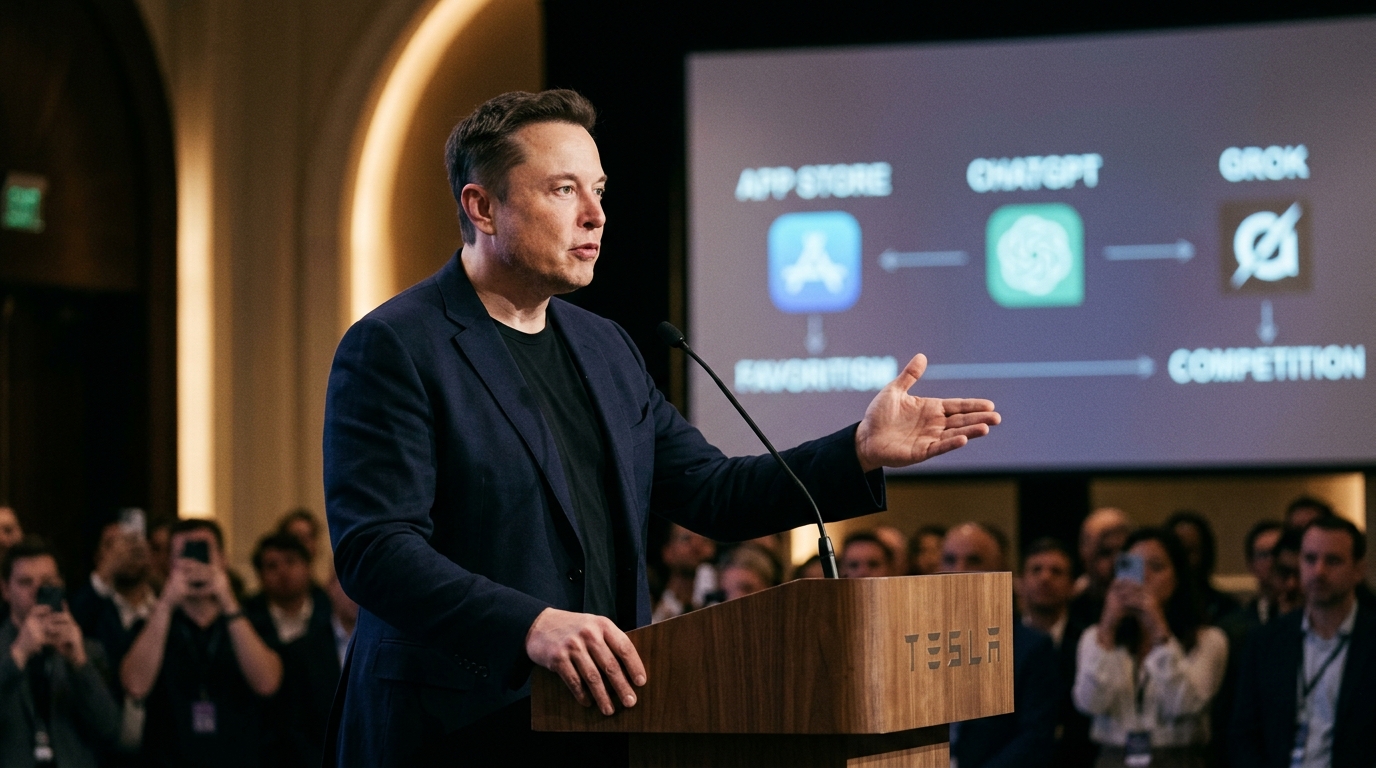
Elon Musk Accuses Apple of Favoring ChatGPT in Its App Store to the Detriment of Grok
Elon Musk has reignited the battle of artificial intelligences by accusing Apple of anti-competitive practices. According to him, the App Store gives an advantage to ChatGPT, OpenAI's conversational agent, at the expense of Grok, the AI developed by his company xAI.
Elon Musk has reignited the battle of artificial intelligences by accusing Apple of anti-competitive practices. According to him, the App Store gives an advantage to ChatGPT, OpenAI's conversational agent, at the expense of Grok, the AI developed by his company xAI. This public statement comes amidst growing tensions between tech giants, where artificial intelligence has become a strategic as well as economic battleground.
A Duel Between Two Visions of AI
Since its launch, Grok aims to stand out with its direct, sometimes provocative tone, and its integration into the X ecosystem, formerly Twitter. In contrast, ChatGPT, widely adopted around the world, benefits from a massive network of integrations, ranging from office software to search engines.
Musk accuses Apple of limiting the visibility and accessibility of Grok on the App Store. According to him, these restrictions reflect a desire to protect a dominant player—OpenAI—with which Apple has strengthened its strategic ties. As reported by Le Monde, this accusation puts the Californian group under recurring criticism for its app store management, already flagged by regulatory authorities for practices deemed too restrictive.
A Debate That Goes Beyond Simple Competition
Beyond the standoff between Musk and Apple, the issue raises broader stakes. The AI ecosystem is now dominated by a few giants capable of locking user access through their platforms. The risk, according to several experts, is the emergence of a de facto monopoly, where only partners of major tech platforms could thrive.
For Musk, this situation poses a threat not only to innovation but also to the diversity of approaches in AI. The debate echoes broader concerns already raised in Europe and the United States: how to ensure fair competition in a sector where development costs are colossal and where market entry points—the app stores—are themselves controlled by a few companies?
A Battle That Could Extend to Legal Grounds
If Musk's accusations were to turn into legal proceedings, they could revive discussions on the regulation of App Stores and the neutrality of access to digital markets. Apple, for its part, generally defends its practices in the name of security and quality of user experience. But this line of defense could prove fragile if public opinion perceives blatant favoritism towards OpenAI.
The emerging question is thus twofold: should platforms remain free to favor certain strategic partners, or should they ensure fair access to all developers, including those who become direct rivals?
By accusing Apple, Musk is not just defending Grok. He is opening a new front in the AI war, a conflict where the balance between innovation, regulation, and competition is far from being found.