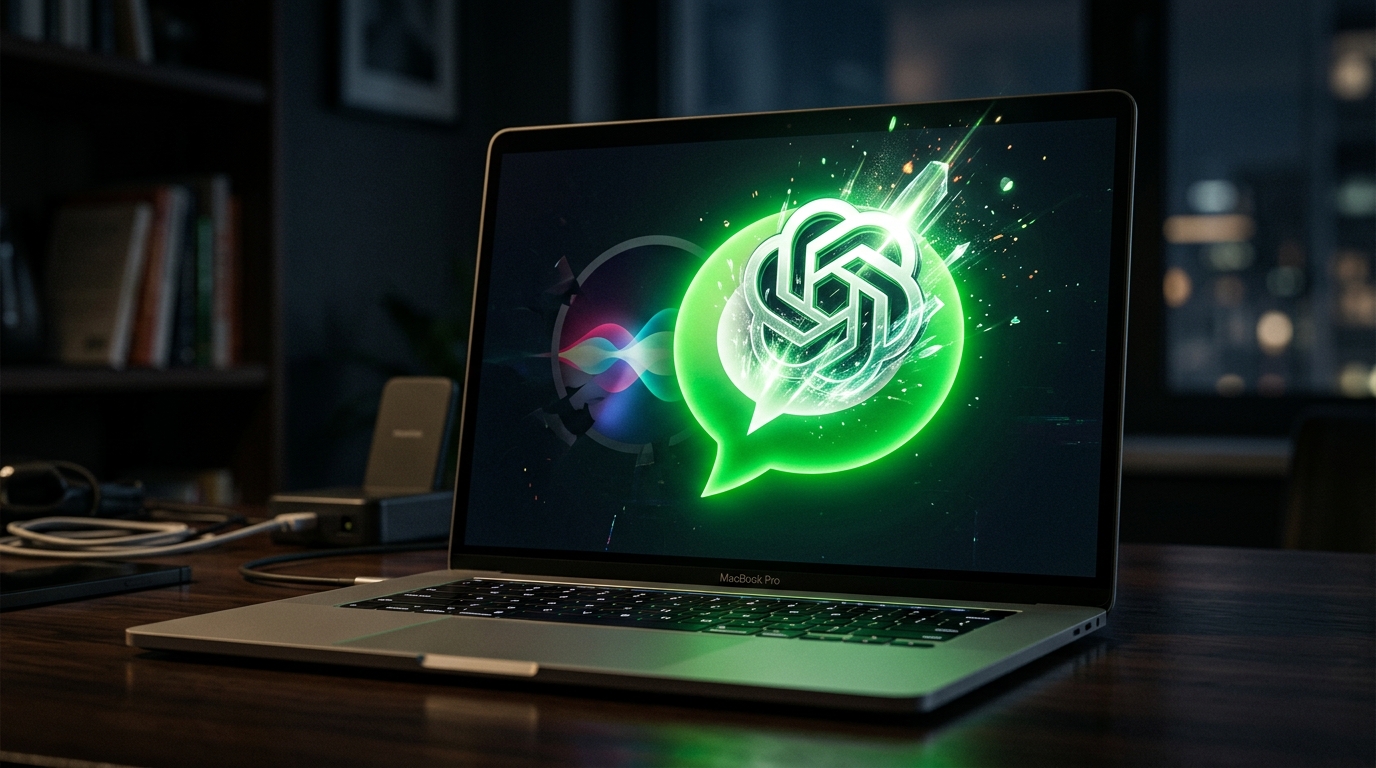
ChatGPT Takes Control of iMessage on Mac: OpenAI Encroaches on Siri's Turf
On August 20, OpenAI launched a macOS plugin that allows ChatGPT to read, search, summarize, and send iMessage, SMS, and RCS messages. Full disk access required, tension with Apple, direct competition with the future AI Siri. A breakdown of a technical takeover.
On August 20, 2026, OpenAI quietly rolled out an update to its ChatGPT for macOS app with an integration that's sure to ruffle feathers in Cupertino: an Apple Messages plugin that allows ChatGPT to read, search, summarize, and send messages — including iMessage, SMS, and RCS. No partnership agreement, no coordinated announcement: OpenAI is simply using open macOS APIs to gain a foothold in Apple's messaging system.
What the plugin actually does
- Read past conversations and retrieve their context
- Search the history by keywords or contact
- Summarize a long conversation or group thread
- Draft responses in the user's style
- Send messages — with manual approval by default
The plugin works in ChatGPT Work and Codex modes, and — a strategic surprise — even for free users. OpenAI is deploying it without a paywall, like a Trojan horse to convert Mac users to ChatGPT as a system layer.
Technical limitations
Two restrictions to note:
- Apple Silicon Macs only (M1, M2, M3, M4…). Intel Macs are excluded.
- The plugin requires heavy system permissions: Full Disk Access, access to contacts, authorization of macOS automation tools.
This is where it gets sensitive: Full Disk Access is the master key. Once granted, the app can technically read any user file, not just Messages.
OpenAI's privacy promise
OpenAI claims that processing is done locally on the machine and that no “general index” of all messages is built or sent to its servers. The company specifies that only the messages necessary for the current request are sent to the model. The user must also approve each send by default before ChatGPT pushes a message to a recipient.
The fact that an OpenAI tool could pull Apple client data to its own network raises questions, regardless of the technical guarantees announced.
The formula is explicit among several analysts cited by Forbes and BeEncrypted: simply granting Full Disk Access to ChatGPT changes the nature of the trust contract. The security community will need to verify that the promise holds in practice.
Why Apple is in an uncomfortable position
This announcement comes amid open friction between the two companies. Last month, Apple filed a lawsuit against OpenAI, accusing it of stealing information on unreleased Apple products. Apple must now choose its response to the Messages plugin:
- Let it pass — at the risk of technically validating a use that contradicts its “privacy first” brand.
- Block it via an API restriction or a specific signature requirement — at the risk of being accused of anti-competitive behavior to protect the future AI Siri.
The parallel with the Beeper Mini case is immediate: when Apple closed iMessage access to Beeper at the end of 2023, the company was harshly criticized for using security as a competitive pretext. A repeat is possible.
Direct competition with AI Siri
The timing is no accident. The new AI-powered Siri, presented at WWDC 2024 and gradually deployed with iOS 19 since late 2025, promises exactly what ChatGPT does today on Mac: browsing messages, summarizing threads, preparing responses. It was intended as a key differentiator for Apple against third-party chatbots.
OpenAI has just short-circuited this argument. If a user can do all this with ChatGPT today, they won't patiently wait for AI Siri to reach the same level. For Apple, it's a real commercial blow — especially since Tim Cook recently announced that heavy AI Siri users will have to pay via a dedicated iCloud+ tier (see our dedicated article).
The nuance to keep in mind
Three points temper the enthusiasm:
- It's Mac only. iPhone and iPad remain out of scope — and that's where 90% of iMessage volume occurs.
- The plugin is useful but not magical: without deep system integration (like Apple can offer to Siri), it remains a desktop tool dependent on the open ChatGPT app.
- The target user base — active Apple Silicon Macs on ChatGPT desktop — likely represents a few million global users, not the 2 billion active Apple devices.
What to watch
Three short-term milestones:
- Apple's technical reaction: macOS update that restricts the concerned permissions? The next macOS 16 beta is expected in September.
- An iPhone version. If OpenAI manages to bypass iOS restrictions to bring the plugin to iPhone — via a Shortcuts extension or widget integration — it's a radical scale change.
- Google Gemini's response. An equivalent plugin for Google Messages, or enhanced integration with Android, shouldn't be far off.
What ultimately matters: OpenAI is building its own system layer step by step. iMessage today, Gmail yesterday, Slack tomorrow. In the end, ChatGPT won't just be an app you open — it will be the intelligence layer that inserts itself into all other apps. Apple, Google, and Microsoft each defend their territory. OpenAI, however, advances in overlay. It might be the most effective strategy to dominate the consumer market without owning the OS.