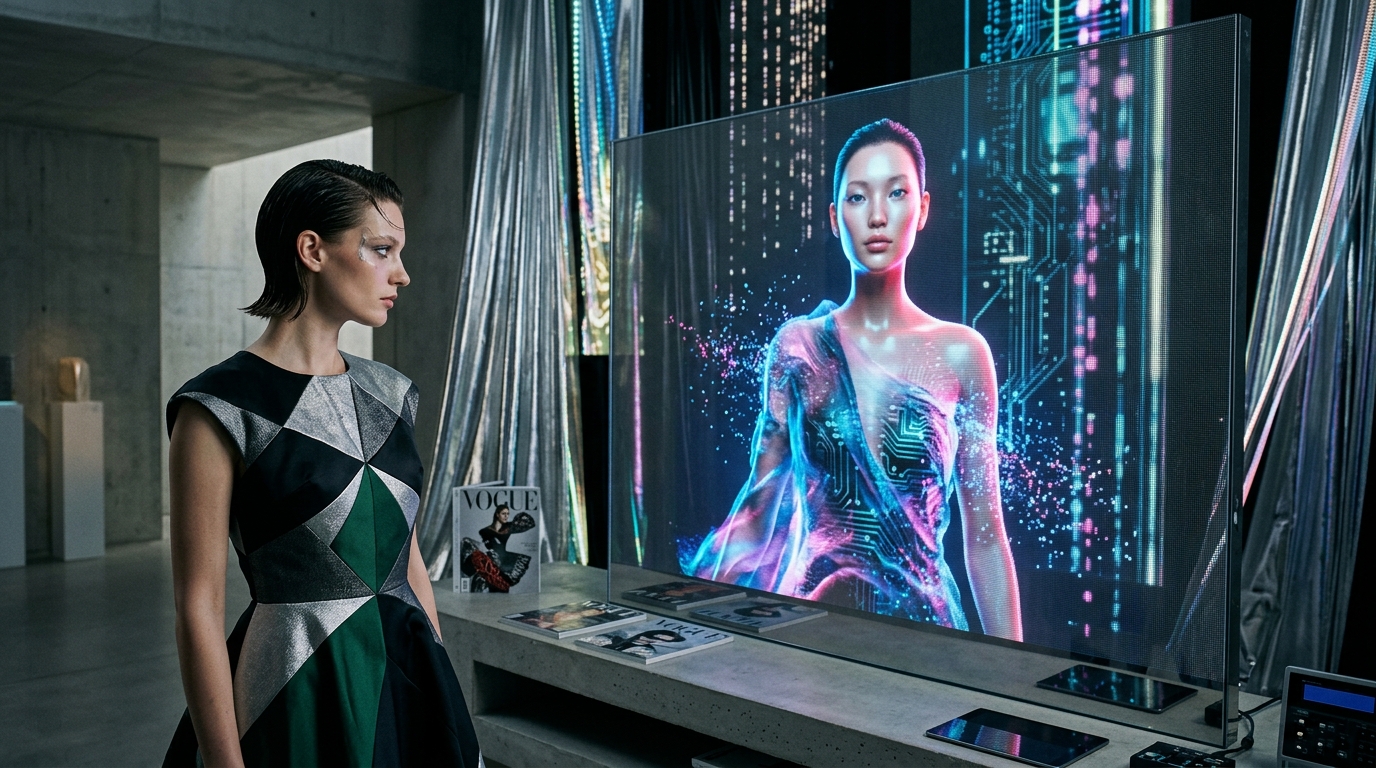
Vogue and the AI Model: Between Technical Prowess and Aesthetic Discomfort
The cover of Vogue magazine's August 2025 issue sparked more puzzlement than admiration. To illustrate a feature on fashion and artificial intelligence, the editorial team chose to
The cover of Vogue magazine's August 2025 issue sparked more puzzlement than admiration. To illustrate a feature on fashion and artificial intelligence, the editorial team chose to depict a woman entirely generated by AI, posing like a flesh-and-blood model, made-up, dressed, styled... but fictitious. While the initiative aimed to be avant-garde, it triggered a wave of negative reactions from readers, internet users, and industry professionals.
The controversy, notably reported by Le Huffington Post, quickly crystallized around several points. First, on principle: was it really necessary to give a spot traditionally reserved for human models, already facing increasing job insecurity, to an algorithm-generated character? Then, on form: while the artistic intent is not debated, the lack of transparency is troubling. The magazine did not clearly indicate that the image was artificial on the cover, leaving some readers to believe it was a traditional photo.
This ambiguity fosters confusion with consequences that extend far beyond aesthetics. By creating perfect, smooth, and unreal images, AI risks reinforcing already unattainable standards in the fashion world. While digital retouching has long been criticized, the arrival of entirely fictional characters opens a new era: one where humans could become secondary in campaigns meant to sell products to humans.
Criticism also arises from creators and photographers, many of whom denounce a form of "silent betrayal." For them, it's not just an artistic experiment but a signal sent by one of the world's biggest fashion references: that of a programmed replacement. Behind the AI-generated model, there is no stylist, no makeup artist, no photographer... just a machine, some prompts, and an editorial line approving the operation.
Even more concerning, this trend is part of a broader context of massive AI use in cultural industries. Cinema, advertising, video games: examples are multiplying where synthetic faces replace real actors or models. Yet, this substitution, even partial, raises questions about the place we still wish to give human creation in a landscape saturated with algorithm-produced content.
Some innovation advocates see it as an opportunity for multiplied creativity, a way to push the boundaries of imagination. But at what cost? The image of this perfect model, who doesn't age, doesn't demand anything, and doesn't ask for a salary, resonates more as an industry fantasy than a social progress.
The question is not to ban AI from covers or campaigns, but to set clear limits on its use. Can an artificial character represent a brand without explicit mention? Should we legislate on mandatory disclosures of generated content? And above all, how do we preserve the diversity of bodies, origins, and stories in a visual world where AI tends to homogenize everything it touches?
The Vogue case thus reveals a growing tension between technological advancement and editorial responsibility. In a sector like fashion, whose cultural impact is considerable, every image counts. Using an AI model is not neutral. It reflects a worldview where humans become optional, where perfection is simulated, and where emotion is replaced by calculated aesthetics.
Faced with this new reality, editorial teams, brands, and even public authorities will need to question: how far are we willing to go in the virtualization of the real? And what do we wish to say about the world through the images we produce and consume?