
Usage and Geography; What the Anthropic Economic Index 2025 Reveals
The Anthropic Economic Index – September 2025 reveals an unprecedented mapping of AI adoption worldwide. Behind the numbers, deep geographical disparities, contrasting uses
The Anthropic Economic Index – September 2025 reveals an unprecedented mapping of AI adoption worldwide. Behind the numbers, deep geographical disparities, contrasting uses between individuals and companies, and above all, major consequences on the labor market. Who's advancing, who's stagnating, who's lagging behind? This report sheds light on the fault lines... and the levers for action.
Massive Adoption in the United States for Claude
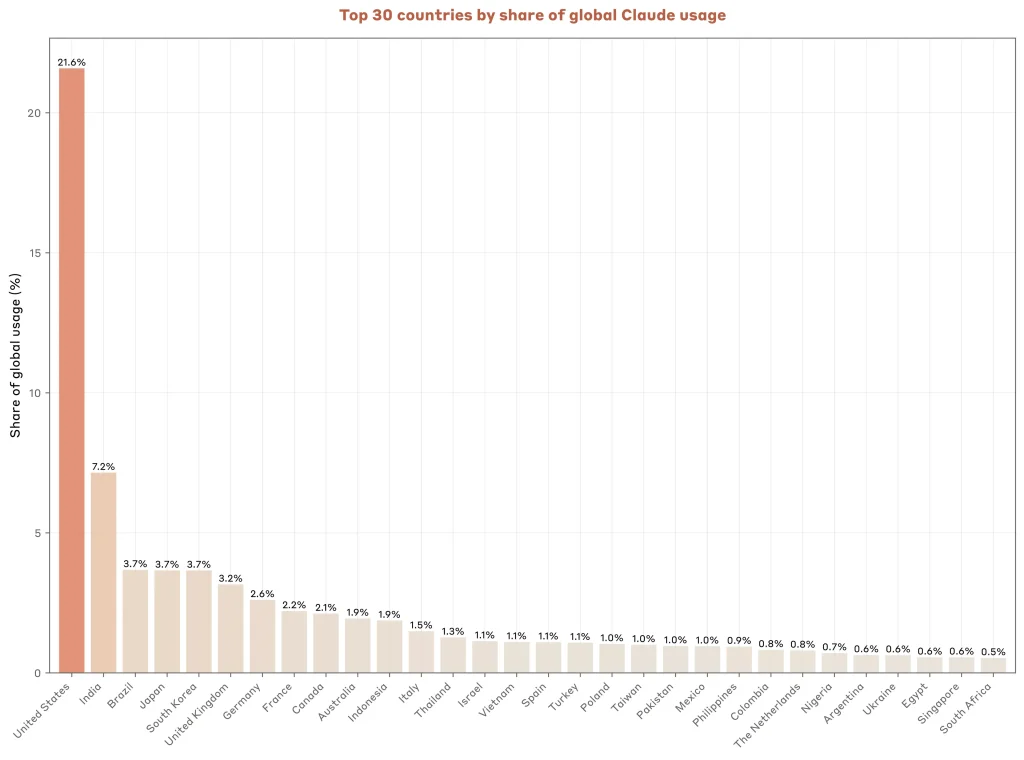
The United States ranks among the most advanced countries in AI adoption. According to the report, nearly a quarter of Americans aged 15 to 64 already use AI in their professional daily lives. This adoption is particularly concentrated in major metropolitan areas like San Francisco, Los Angeles, New York, or Boston, where the tech, financial, and creative sectors are strongly represented.
But it's not just the number of users that's impressive: it's also the diversity of uses. AI is employed to automate code, write content, assist students, accelerate scientific research, or support marketing teams. Most importantly, it is often used collaboratively, like a true intelligent teammate: users don't just give orders, they engage in dialogue with AI, refine their ideas, and test multiple approaches. This style of interaction shows a higher level of maturity than in other parts of the world.
While the United States leads in absolute volume, some countries go even further when AI usage is related to the number of active inhabitants. This is notably the case for Singapore, a true global champion in per capita adoption. There, AI is fully integrated into public administration, educational policies, and business tools.
Canada also stands out with a qualitative approach focused on education, research, and health. Switzerland, on the other hand, uses AI massively in the banking and legal sectors, where rigor and precision are indispensable. In South Korea, AI is omnipresent in education, telecoms, and digital culture, sometimes from a very young age.
The report highlights a direct link between the quality of digital infrastructure — broadband, sovereign cloud, connected equipment — and the level of AI adoption. It's not just about national wealth, but strategic vision.
Uses Reflecting Each Country's Priorities
Each country develops its preferred AI uses based on its cultural, economic, and social specificities. In Singapore, AI is mainly used in administrative processes and education. In the United States, it is omnipresent in coding, communication, and content creation. In Canada, the focus is on socially valuable uses: teaching, scientific research, and public services.
In Switzerland, AI plays a key role in contract review, compliance analysis, and risk management in the banking and legal sectors. In South Korea, it assists students with their homework, supports teachers, and contributes to the production of visual or interactive content for digital platforms. Finally, in countries like India or Nigeria, AI is often used more directly as a lever for professional integration: CV writing, translation, online micro-tasks, etc.
This mapping of uses confirms one thing: where AI is well integrated, it doesn't just replace — it profoundly transforms ways of doing, learning, producing, and cooperating.
On the Usage Side: Coding at the Top!
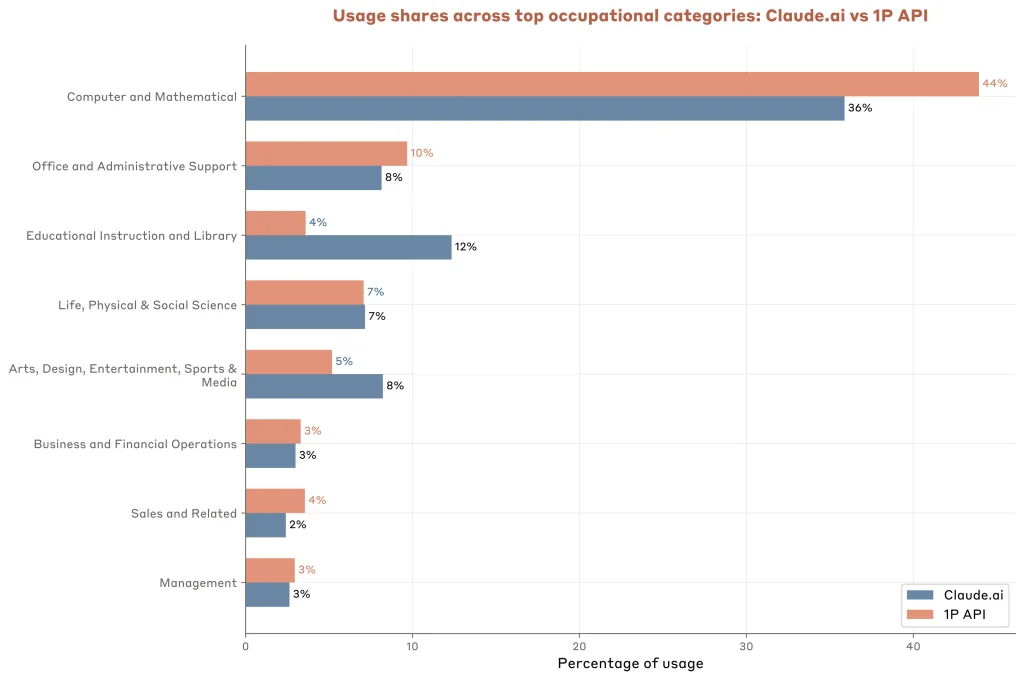
The report confirms that coding remains the most frequent use, whether through direct access (Claude.ai) or via API. Requests cover code generation, debugging assistance, language translation (e.g., from Python to JavaScript), and technical documentation writing. Notably, this usage is not limited to developers. Non-technical profiles are embracing AI to create small scripts, prototype sites, or automate recurring tasks, significantly broadening the user base. In companies, coding via API is highly sought after to accelerate development cycles, automate processes, or build internal assistants.
While coding remains dominant in total volume, educational and scientific uses are rapidly advancing. In education, AI is used to clarify difficult concepts, prepare presentations, generate progressive exercises with solutions, equip teachers (quizzes, notes, materials), and serve as a virtual educational assistant in under-resourced areas.
In research, it summarizes academic articles, helps structure experimental protocols, promotes interdisciplinary exploration, handles translation and reformulation of publications, and automates repetitive tasks (data cleaning, simulation scripts, visual preparation).
Complementary Uses on the Rise
The functional enrichment of Claude is giving rise to several families of cross-cutting uses:
- Live web research: sector monitoring, news synthesis, fact-checking, reputation analysis.
- “Research” mode: sustained work on long corpora, literature reviews, structured research iterations.
- Multimedia: image analysis, PDF annotation, visual creation (diagrams, posters, educational materials).
- File work: spreadsheet analysis, data reformatting, multi-source syntheses (PDF + Excel).
- Prompt and agent engineering: reusable prompts by profession, specialized assistants, connected automations (Notion, Slack, Zapier, Airtable).
- Editing, co-writing, and translation: stylistic adaptation, rewriting internal documents, producing long and multilingual content.
The report notes an increase in so-called “directive” interactions, where the user delegates a clear task and expects a final result (“do X”), with fewer back-and-forths. Conversely, “collaborative” exchanges involve iterating with AI to co-construct a deliverable (brainstorming, reformulations, successive versions). This rise in directive uses is accompanied by a decrease in time spent correcting or “debugging”: models more often deliver outputs directly usable for standardized tasks.
Next, the nature of use varies geographically. In high-adoption areas, AI mainly serves as an integrated thought partner in workflows (augmentation): it is used for thinking, structuring, reviewing, monitoring. In regions where adoption is more recent, interactions remain more directive and execution-oriented: AI produces a text, translates, generates a plan, or a one-off deliverable. In other words, the more mature the ecosystem, the more AI is used collaboratively.
Finally, two usage frameworks coexist. On the consumer side, the chat interface favors iteration, exploration, and personal assistance (writing, understanding, learning, simple coding). On the enterprise side, API integration aims for silent execution at scale (batch document processing, HR automation, legal analysis, CRM, reporting). API uses are mostly “complete task,” non-conversational, and fit into tool chains (ERP, HRIS, ATS, CRM), with supervision and quality control at the end of the chain.
Top Tasks in Business
API volumes show five dominant areas:
- Coding and development (code generation/refactoring, documentation, testing),
- Administrative and documentary (reports, contract analysis, meeting summaries, forms),
- Internal tools and assistants (business agents, document research, natural database querying),
- Marketing and communication (product sheets, emailing, landing pages, video scripts, SEO/sentiment analysis),
- Recruitment and HR (pre-analysis of CVs, job offer writing, interview summaries, onboarding kits).
Notable accelerations include financial files, responses to calls for tenders, customer feedback summaries, and compliance assistance (GDPR, ESG).
The unit cost per task matters less than one might think. What determines value is the model's capability (reasoning, robustness, ability to handle ambiguity) and the quality of the provided context (clean internal data, up-to-date documents, text or code templates, precise instructions). Low-cost automation but poorly contextualized produces “silent” errors. Conversely, a powerful model, correctly “fed” with business context, delivers substantial productivity and quality gains, justifying the investment.
Impact and Recommendations of the Report
The report highlights that a gap may widen between advanced and emerging economies. The former, already well-equipped with digital infrastructure, human capital, and a stable regulatory framework, capture productivity and innovation gains from AI more quickly. Conversely, many countries with slower adoption risk technological lag: unequal access to tools, more sporadic uses, weak integration into organizations. Possible consequences: amplification of productivity gaps, increased technological dependence, educational divide (learning with AI vs. without), loss of digital sovereignty. However, the report reminds of catch-up levers: investment in infrastructure, dissemination of open tools, linguistic localizations, and targeted deployments in education, health, or agriculture, through public-private partnerships.
AI reconfigures the value of tasks more than it massively destroys jobs. The “winners” are profiles capable of augmenting their work with AI: developers who prototype faster, writers who industrialize style variation, lawyers and analysts who synthesize better and faster, trainers who enrich their materials. Positions composed mainly of repetitive and standardized tasks are more exposed (data entry, simple reformulation, first-level support responses, highly formatted content). The determining factor becomes adaptability: the same job can win or lose depending on AI use (copilot vs. tool ignorance). The structuring boundary opposes automatable tasks (simple summaries, standard translation, basic extractions) to tasks with high contextualization or tacit expertise (negotiation, strategic framing, sensitive legal interpretation, choosing relevant visualizations). Two movements are observed: a “vertical” rise towards more analysis and decision-making, and a “horizontal” rise of hybrid professions (prompt engineering, conversational UX, knowledge curators, AI/no-code project managers).
Recommendations for Companies: Move from Experimentation to Value
- Organize and prepare data
Centralize scattered documents, clean and structure business databases, define access standards. An AI without reliable context remains shortsighted; a “fed” AI becomes useful for core business tasks. - Train by use case and create references
Go beyond generic demonstrations. Train by sector (HR, legal, finance, marketing, operations), equip teams, establish AI references, and integrate AI into skill development paths. - Adapt processes and roles
Rethink validation circuits (who reviews, who signs, who measures), create AI supervision roles (quality control, compliance), and align indicators (time savings, quality, adoption rate, error rate). - Integrate via API into existing tools
Deploy AI where work happens (CRM, ERP, HRIS, helpdesk). Prioritize “complete task” cases with high ROI, industrialize, instrument monitoring (dashboards, SLA, auditability). - Governance, security, and compliance
Develop a usage charter, frame authorized/forbidden zones, involve business units, DPO/GDPR, and CISO from the start, track uses, and establish ex-post controls for reliability and compliance (European AI regulation, GDPR).
Value no longer depends on the unit cost per task, but on the alignment between model capability, context quality, and absorption process in the organization. Winning companies are those that industrialize high-impact use cases while professionalizing data, skills, and governance.
An Irreversible Trend
The report confirms a now visible trend on the ground: artificial intelligence is no longer confined to research or technical professions — it is gradually infiltrating all layers of the company, across all sectors, and in an increasing number of countries. Although Claude is currently strongly centered on the United States, this global adoption dynamic is consistent with all market studies.
Another strong signal: the transition to automation is accelerating. Until now, automated uses via API were mainly reserved for large structures with technical teams, the emergence of AI agents and no-code platforms now paves the way for a democratization of automation. It's not just conversational AI that's progressing: it's executable AI, capable of handling end-to-end business tasks.
In this context, companies that can structure their data, train their teams, and intelligently equip their processes will gain a significant competitive advantage. The challenge is no longer to “test AI,” but to integrate AI as a strategic building block, both pilotable, scalable, and ethical.