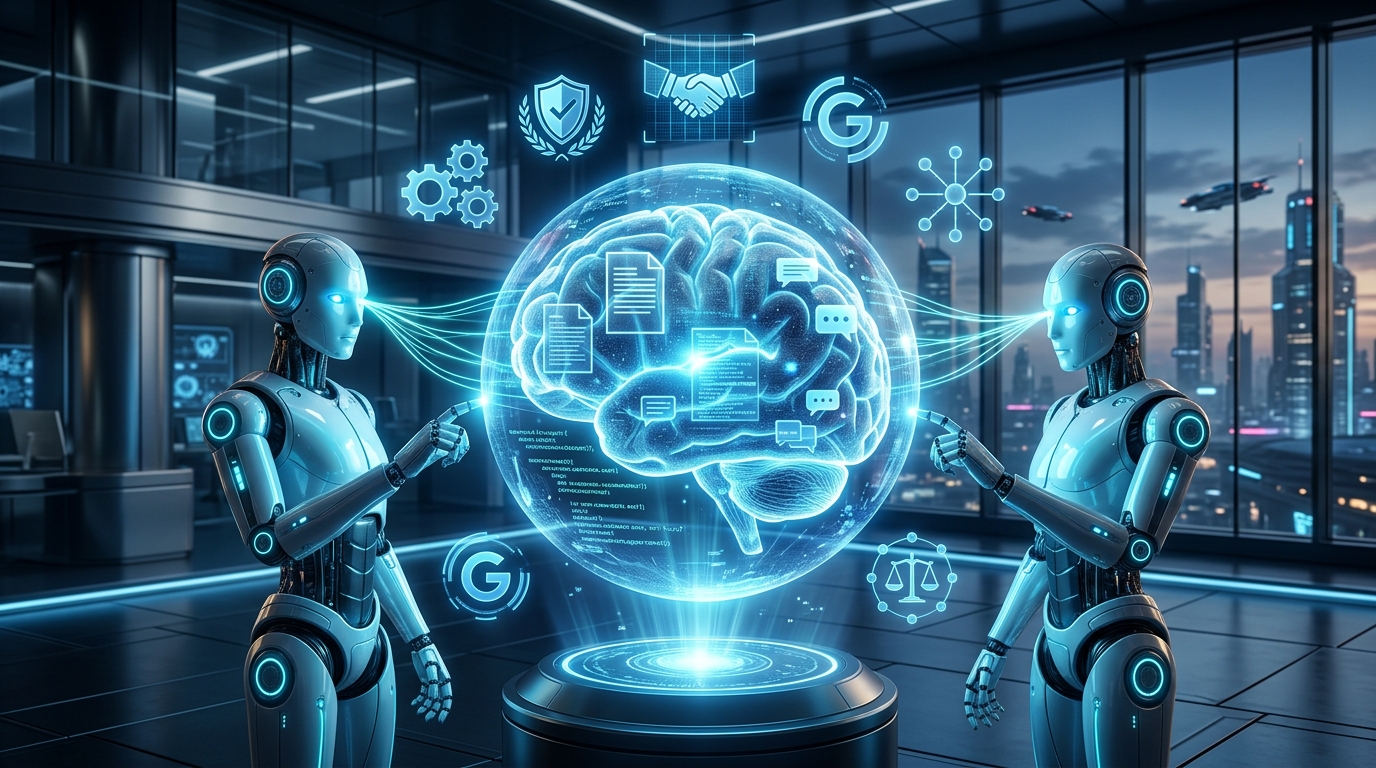
TencentDB Agent Memory v2: AI Agents Finally Share a Team Memory
Tencent Cloud releases the code for Team Memory, an extension of its TencentDB Agent Memory project (20,000 GitHub stars in 90 days) that allows multiple AI agents to share conversations, code, and documents with fine-grained governance. Industrial multi-agent systems are taking shape.
Tencent Cloud announced on August 13, 2026 the release of version 2.0 of its open-source project TencentDB Agent Memory, adding a feature that the AI agent industry sorely needed: team memory. In other words, the ability for multiple AI agents to share a common context pool — conversations, documents, source code, action history — with a fine layer of governance.
The project has reached 20,000 GitHub stars in 90 days since its open-sourcing in May 2026. It's one of the fastest adoptions of the year in the agent ecosystem.
What Team Memory Solves
Until now, agent frameworks (LangChain, CrewAI, AutoGen, OpenClaw) gave each agent its own isolated memory. Two agents working on the same project couldn't effectively share their context — leading to recalculations, lost context, and inconsistencies.
Team Memory introduces a central hub where artifacts produced by an agent (or a human) become memory items reusable by other authorized agents:
- Past conversations with a client
- Validated code repositories and snippets
- Operational documents and procedures
- History of decisions and actions
These items are then dynamically assembled by role and task to be injected into the agents' context. Compatible with major frameworks — Tencent lists CodeBuddy, OpenClaw, and Claude Code.
The Governance Layer: What Enterprise Multi-Agent Was Missing
This is where Tencent takes enterprise specificity seriously. Each memory item supports:
- Ownership: who created it, who owns it
- Versioning: modification history
- Status: draft, validated, obsolete, archived
- Usage log: which agents/users have viewed or modified it
- Permissions configurable by user, role, and agent
This is the first open-source building block that meets the post-incident UK AISI IT departments' requirements: audit logs, permission boundaries, human review (see our dedicated article). Not coincidentally, these requirements have tightened over the summer.
Isolated multi-agent was a toy. Governed multi-agent becomes a real system component.
The Chinese Strategic Context
Tencent is playing the same card as Alibaba with Qwen or Moonshot with Kimi: massively opening up to capture the global developer ecosystem. Faced with OpenAI and Anthropic closing their models, Chinese players are investing in open source as a geostrategic weapon.
The displayed compatibility with Claude Code is notable: Tencent is not building a silo; it's offering a complementary component to the Anthropic framework — which itself lacks native team memory.
Key Takeaways
- Multi-agent is becoming a real enterprise topic, not just a Twitter demo.
- The Chinese pattern — open source + solid governance — is emerging as the most credible adoption path for agents in 2026-2027.
- Major Western proprietary frameworks will need to respond — expect an equivalent announcement from Anthropic or OpenAI in the next 3-6 months.
The Nuance
An open-source project of 3 months reaching 20,000 stars — it's excellent, but there's no guarantee yet that TencentDB Agent Memory will handle production loads on fleets of 100+ concurrent agents. Large-scale scalability benchmarks are missing. And the integration ecosystem is still young: LangChain, CrewAI, and AutoGen don't have official connectors yet.
Nonetheless, the direction is clear: the memory layer is becoming as central an infrastructure component as the database or message broker. Those who master it will control the agent layer.