Stellar Blade: Blood Rain — The 100% AI Clip from Shift Up Sparks Outrage Among Fans
The Korean studio Shift Up released a fully AI-generated music video at the end of July 2026 to promote Stellar Blade: Blood Rain. The fan reaction was harsh: 'AI slop', 'deeply disappointed', tens of thousands of negative comments. A look back at a revealing PR failure.
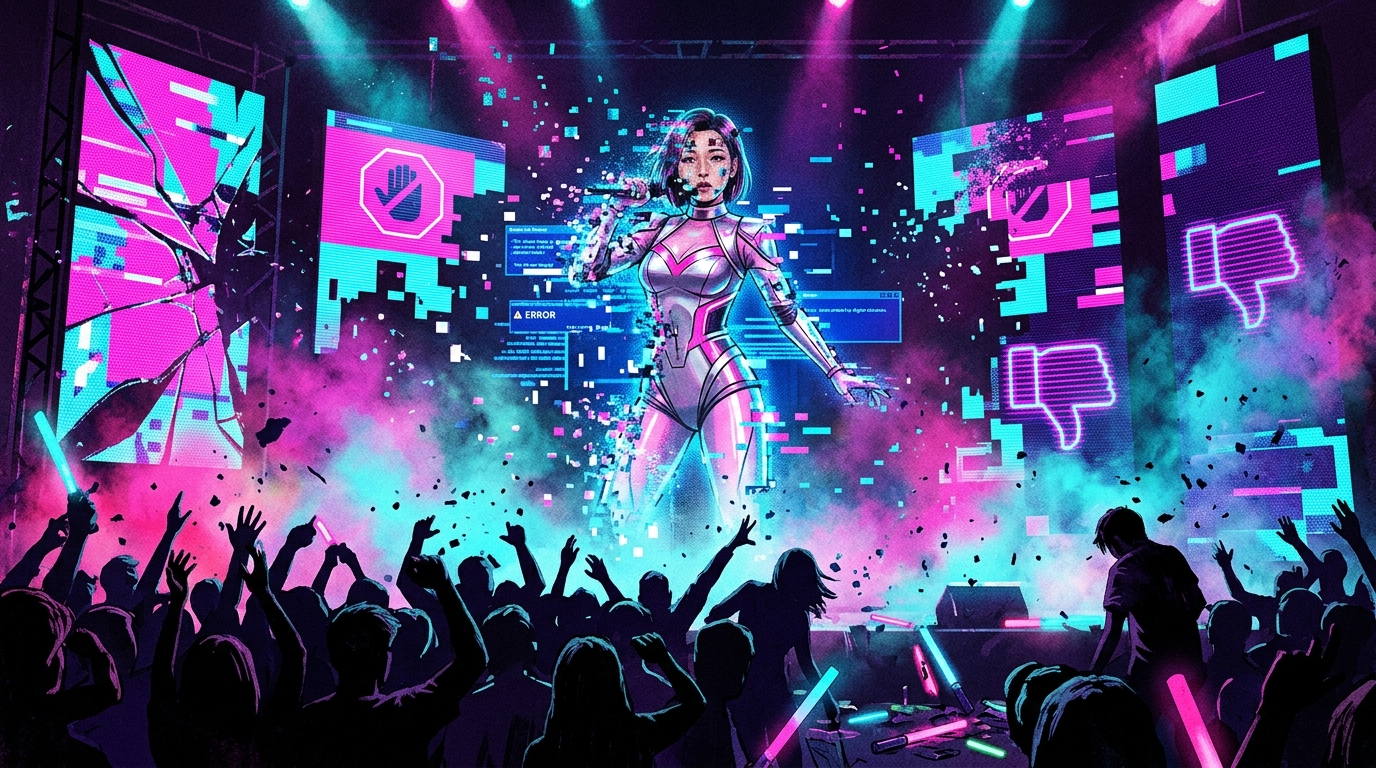
At the end of July 2026, the South Korean studio Shift Up, developer of the hit game Stellar Blade, released a 3-minute 30 music video on its official YouTube channel to promote Stellar Blade: Blood Rain, the sequel to the game. The clip is titled “Wanna be in LOVE” Feat. Evie — Evie being the new protagonist — and features the character as a K-pop idol singing and dancing in a futuristic city directly inspired by the game's universe.
The problem: the video is almost entirely AI-generated. And fans noticed immediately.
Direct link: https://www.youtube.com/watch?v=5Ncuote9ADo
The Content of the Clip
The clip alternates between:
- Choreographed sequences of Evie singing in a neon urban setting
- Exploration shots in an environment resembling those of Blood Rain
- Behind-the-scenes style scenes featuring the Shift Up team interacting with the AI version of the character
The whole production used generative video tools (probably a combination of Sora 2, Runway Gen-4, and derived image-to-video generators). The characteristic artifacts are visible: facial instability between shots, deformed hands, background elements appearing and disappearing, strange transitions.
The Reaction: Relentless
YouTube comments and social media exploded within hours. The recurring descriptors:
- “AI slop” — the term used for low-quality AI-generated content
- “Are we deadass?” — equivalent to “seriously, is this for real?”
- “I feel profoundly disappointed”
- “Where is your art team?” — pointing out the inconsistency for a studio renowned for its character designers
Several specialized media outlets — Kotaku, Push Square, VGC, Game Rant, Dot Esports — covered the uproar within 48 hours, with unambiguous headlines (“Even Stellar Blade fans hate the sequel's official GenAI music video”).
Why Such Anger?
1. It's a Studio Known for Its Craft
Shift Up gained international recognition for the extreme precision of its character design and animation (character physics, hair, fabrics, expressions). Seeing this same studio replace its expertise with blurry and unstable AI faces was perceived as an aesthetic betrayal.
2. The Character is Central to the Product
A video game's main character is a narrative and emotional investment. Seeing it poorly represented in official communication damages the emotional bond fans build with it — and thus the value of the upcoming game.
3. It's the Implicit Announcement of a Choice
If Shift Up uses generative AI for official marketing, the inevitable next question is: is it also used in the game? Generated cutscenes? Synthesized voiceovers? Mass-produced secondary sprites? Fans fear this clip is the tip of a much deeper AI-driven industrialization.
4. It's a Signal Sent to Internal Artists
Shift Up's character designers, animators, illustrators saw their work (their craft) replaced, in this marketing piece, by generators. The message sent is clear: “We can do without you”. It's true at Shift Up, and it could become true everywhere.
The Studio's Position
Earlier in 2026, Shift Up's CEO, Kim Hyung Tae, publicly defended the use of generative AI in the industry. His arguments:
- AI is an “essential tool” for medium-sized studios like Shift Up that must compete with Chinese megastudios (miHoYo, NetEase, Tencent) with almost unlimited resources.
- The technology allows “one person to do the work of 100” without necessarily eliminating jobs — rather by freeing teams for higher-value work.
This position, coherent on paper, clashes with the reality experienced by the public: a marketing clip that deserved 3 months of a real animation workshop was rushed in a few weeks with Runway and Sora. The result visibly betrays the lack of human artistic direction.
The Real Issue: The Line Between “Tool” and “Product”
No one among the fans really disputes the use of AI behind the scenes — for storyboarding, idea generation, brainstorming concept art, secondary texturing. What is rejected is AI on the surface, as a finished product delivered to fans.
The distinction is crucial and could become an implicit industry standard: use AI to speed up your production, but if the final result shows characteristic artifacts (blurry faces, deformed hands, failing temporal coherence), it's laziness, not modernity.
What This Incident Says About the Moment
Three lessons:
- The general public now recognizes AI video at first glance. Tolerances for artifacts (hands, faces, shot-to-shot coherence) are collapsing as tools progress.
- “AI slop” is becoming a clearly identified repellent category. A studio that falls into it damages its brand sustainably.
- There is a social wall between B2B and B2C on generative AI. What passes internally (productivity, prototyping, design aid) does not pass when delivered as is to the public.
Shift Up has not, at the time of this article's publication, removed the video. But the episode will remain a case study to cite in future presentations on “how not to use generative AI for marketing a premium product.”
And for Stellar Blade: Blood Rain, the release scheduled for 2027 starts with a seriously damaged goodwill.