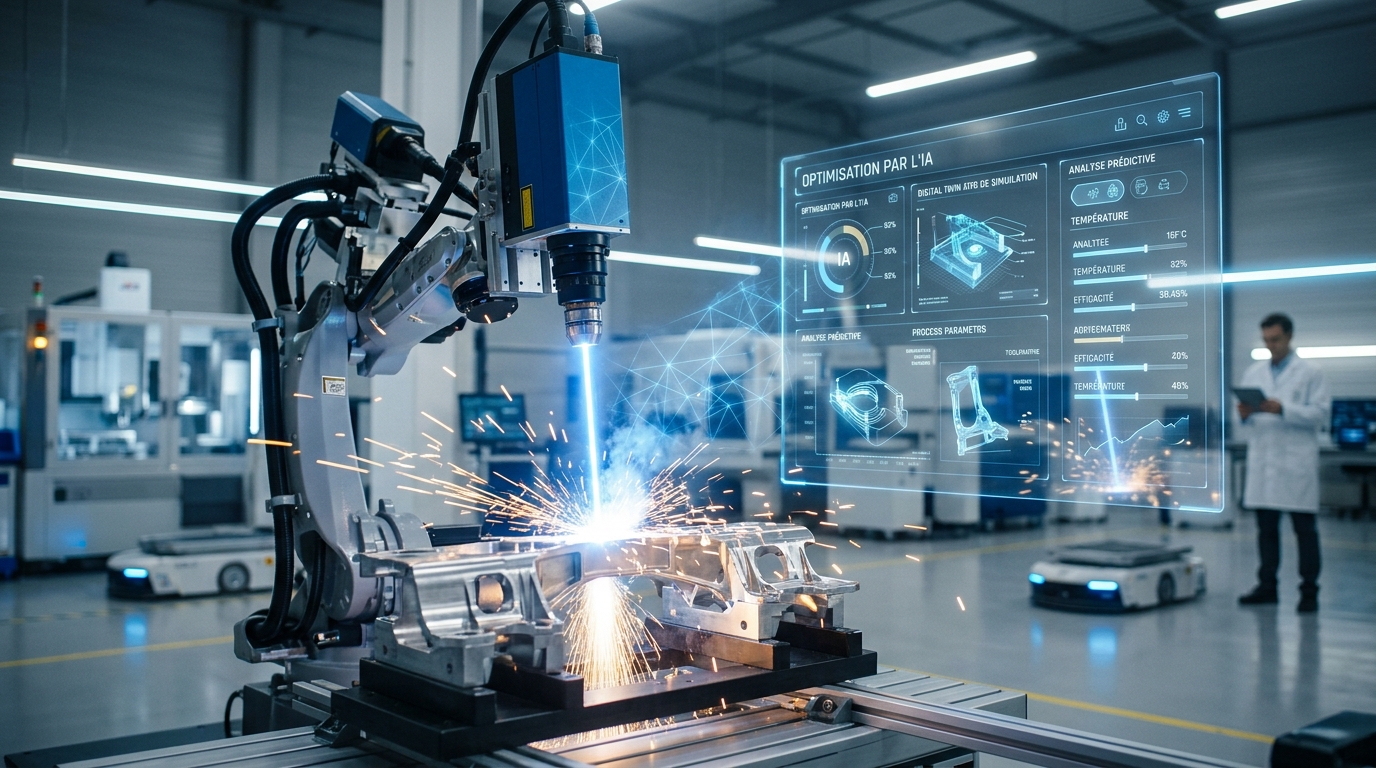
Artificial Intelligence in Manufacturing: Revolutionizing Industrial Laser Processes
In an ever-evolving industrial landscape, precision and efficiency in manufacturing processes are crucial. Laser technologies, especially in the field of additive manufacturing, offer unprecedented possibilities. However, their operational complexity presents a major challenge.
In an ever-evolving industrial landscape, precision and efficiency in manufacturing processes are crucial. Laser technologies, especially in the field of additive manufacturing, offer unprecedented possibilities. However, their operational complexity presents a major challenge. Researchers from the Swiss Federal Laboratories for Materials Science and Technology (EMPA) have recently highlighted the contribution of artificial intelligence (AI) in simplifying and optimizing these processes, paving the way for more accessible and sustainable production.
AI to Simplify Additive Manufacturing
Powder Bed Fusion (PBF), an additive manufacturing technique, allows for the creation of complex metal parts by fusing layers of metal powder using a laser. This process requires precise adjustments, varying according to materials and geometries, which involves numerous costly and time-consuming preliminary tests.
Researchers Giulio Masinelli and Chang Rajani have developed a machine learning algorithm capable of analyzing optical data from sensors integrated into laser machines. This algorithm identifies the current fusion mode (conduction or keyhole) and adjusts the parameters for subsequent tests, reducing the number of necessary experiments by about two-thirds while maintaining product quality. This advancement makes PBF technology more accessible, even for non-specialists.
Towards Real-Time Optimization of Laser Processes
Beyond the preparation phase, AI can also enhance the laser welding process in real-time. Surface imperfections or material variations can disrupt welding, even with optimal settings. To overcome this limitation, researchers have integrated field-programmable gate arrays (FPGA) capable of instantly reacting to collected data, adjusting laser parameters in real-time. A central computer, acting as a "backup brain," allows the algorithm to learn and continuously improve, thus enhancing the reliability and precision of the process.
The integration of artificial intelligence into industrial laser processes marks a significant step towards more efficient and adaptable production. By reducing costs and the complexity of settings, AI democratizes access to advanced technologies, fostering innovation and competitiveness. This convergence between human expertise and machine intelligence opens new perspectives for the manufacturing industry, placing AI at the heart of industrial transformation.