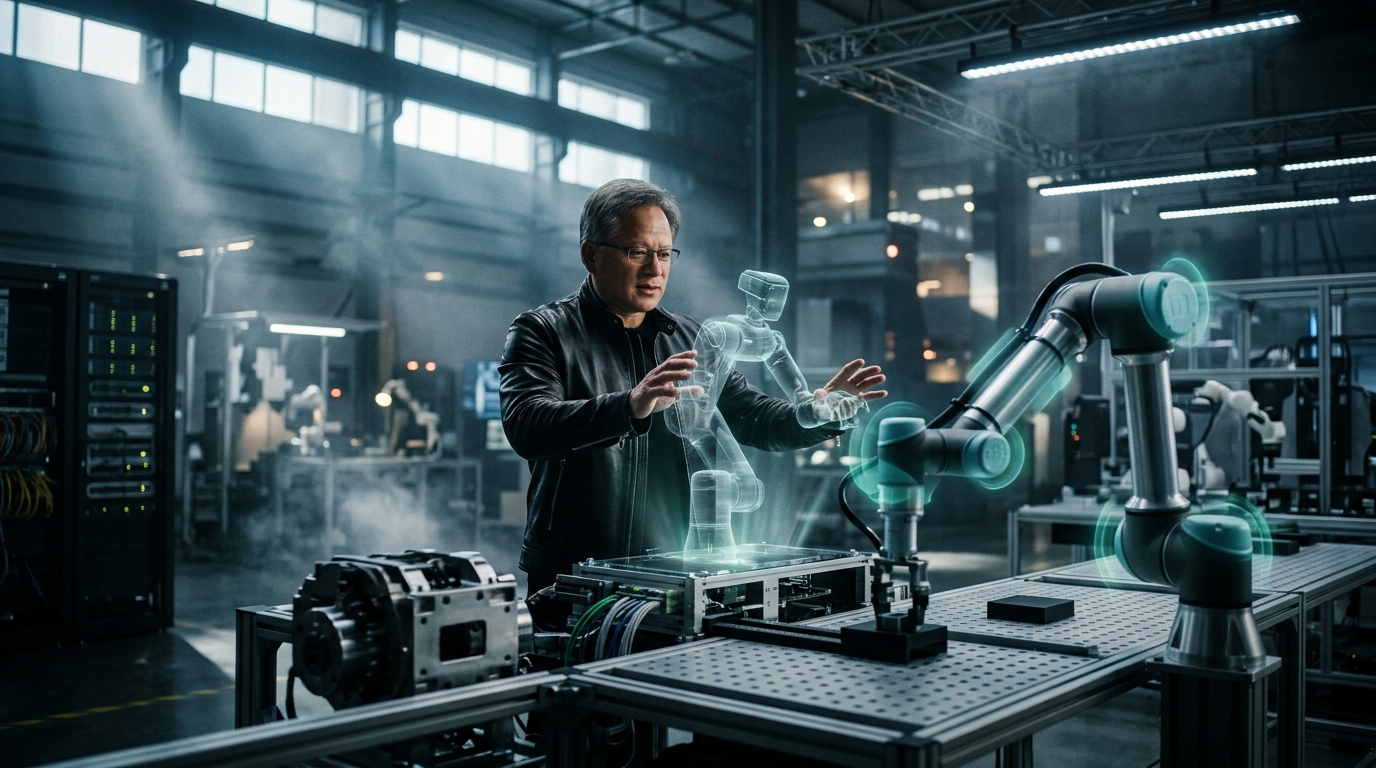
“Physical AI” According to Jensen Huang: The Next Revolution According to the Nvidia CEO
At the Computex show in Taiwan in early June, Nvidia CEO Jensen Huang stated that the next major advancement in artificial intelligence will not only be software-based but also physical:
At the Computex show in Taiwan in early June, Nvidia CEO Jensen Huang stated that the next major advancement in artificial intelligence will not only be software-based but physical: it involves integrating AI directly into real-world robots and machines. This is a strong strategic shift for the leading AI chip company, aiming for a profound transformation of the industry and everyday uses.
From Generative AI to Physical AI: A Paradigm Shift
AI Anchors in the Real World
According to Huang, after the phase of language models and content generators, the future path lies in models capable of understanding the laws of physics and interacting autonomously with the real world. Practically, this means intelligent machines capable of operating in non-virtual environments, like robots in factories or warehouses.
Nvidia Isaac, the Spearhead of AI Robotics
To realize this vision, Nvidia is developing the Isaac platform, already used by groups like BYD Electronics and Siemens. It enables the deployment of autonomous robots in logistics and production, based on digital twins simulated in the Omniverse tool. According to the company, tens of millions of physical AIs, ranging from industrial robots to humanoids, are in the validation process.
Industrial and Economic Stakes: Towards Massive Automation
Increased Robotization of Factories
Huang assures that “all factories will be robotized”, forming the next industrial wave. These machines could perform complex tasks with autonomy and adaptability, based on AI models capable of reacting in real-time and learning from the environment, thus realizing the ambition of physical AI.
A Robust Technological Infrastructure
This industrial transformation relies on a central pillar: computing power. Nvidia, with its Blackwell microarchitecture (B100/B40), provides massive GPUs designed for so-called “generative” AI. The company has seen its revenue skyrocket (+262% in one year, reaching $26 billion), confirming its leadership. This financial success directly fuels its investments in physical AI, reinforcing its dominance.
The announcement of GPS in the era of physical AI is a double-edged ambition: it promises a revolution in the automation of industries and infrastructures but poses major technological, ethical, and economic challenges. Jensen Huang's vision is on a strong trajectory: AI will not stop at screens; it will be embodied in the systems surrounding our daily lives. To succeed in this shift, not only intelligent robots will be needed, but also rigorous governance, energy sustainability, and social acceptance.
Industry, regulators, and civil society will need to closely monitor these transformations: physical AI, far from being science fiction, is entering our reality today. It remains to be seen whether it will be guided by a balance between progress and responsibility.