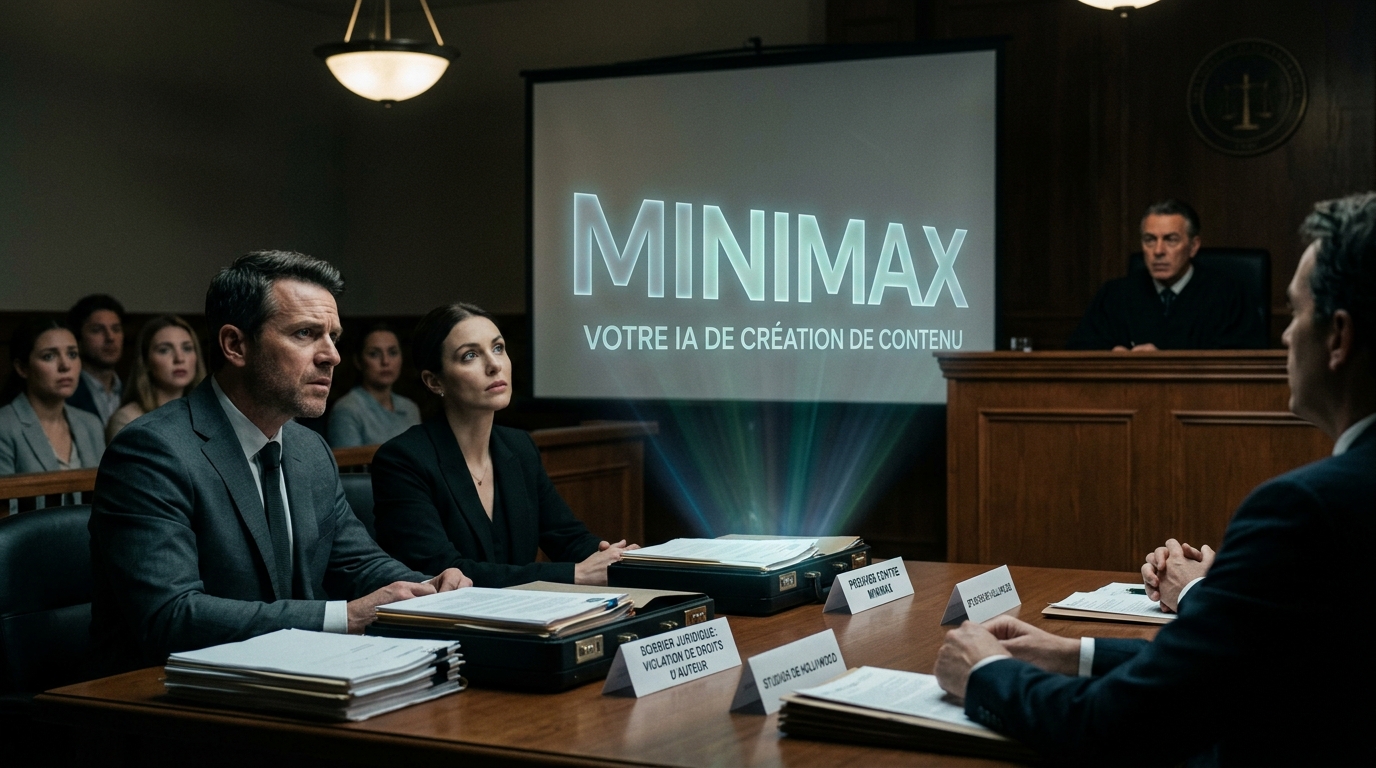
Hollywood vs. AI: MiniMax Targeted by Studios for Copyright Infringement
The giants Disney, Warner Bros Discovery, and Universal have filed a lawsuit against the Chinese company MiniMax, publisher of the video generator Hailuo AI. The issue: training the AI on protected content.
The giants Disney, Warner Bros Discovery, and Universal have filed a lawsuit against the Chinese company MiniMax, publisher of the video generator Hailuo AI. The issue: training the AI on protected content and generating images close to iconic characters. Following Midjourney, this is another confrontation that sets the stage for global AI regulation.
MiniMax, the Chinese startup shaking Hollywood
The company MiniMax, based in Shanghai but also located in Palo Alto, California, develops Hailuo AI, an AI-powered video generator. Like Runway or Pika, it allows users to create short, stylized videos from simple text prompts.
MiniMax presents itself as an innovative player specializing in multimodal models. It has reportedly raised over $250 million since 2022, attracting major Chinese investors in the AI race. But its training model is now at the heart of an unprecedented legal controversy.
Training on protected content without authorization
In the lawsuit filed on September 13, 2025 in the federal court of San Francisco, Disney, Warner Bros Discovery, and NBCUniversal accuse MiniMax of training its AI using protected films, series, and audiovisual works owned by the studios.
In other words: hours of content were copied, ingested, and analyzed by the system without any license or prior authorization.
The goal? To enable the AI to identify narrative styles, camera movements, shot structures, and especially very specific visual universes—those that are the hallmark of Hollywood franchises.
Iconic characters generated on demand
But the issue isn't limited to training. The plaintiffs also denounce the fact that Hailuo AI users can generate videos featuring characters similar to—if not almost identical to—those from their licenses: Disney princesses, Marvel superheroes, fantastical creatures...
These creations, sometimes shared on social media, flirt with counterfeiting. They allow, with a simple request, the recreation of the appearance, attitudes, or graphic codes of a character subject to copyright and trademark rights.
For the studios, this constitutes abusive commercial exploitation, which undermines the value of their franchises, while escaping any form of editorial or artistic control.
Disney has already sued Midjourney
MiniMax is not an isolated case. In June 2025, Disney and NBCUniversal had already filed a lawsuit against Midjourney, the famous AI image generator based in San Francisco. Here too, the grievances were about:
- Unauthorized use of protected works to train the model;
- Midjourney's ability to generate illustrations directly inspired by the universe of franchises like Star Wars, Frozen, or Shrek.
This dual legal front shows an aggressive strategy: Disney and other majors now want to strictly regulate the use of their content in the AI economy.
Generative AI relies entirely on data
This type of legal action raises a fundamental question: how does generative AI work?
Whether creating an image, text, or video, an AI needs to be trained on millions of data points. For an image generator, this means illustrations, photos, posters. For a video generator, it often involves film clips or animated sequences.
These data allow the model to learn to recognize shapes, sequences, styles, patterns, which it can then "mix" to produce a new creation.
But in many cases, the databases used are neither public nor royalty-free. And AI companies do not always disclose their sources.
The backlash from highly lucrative industries
For a long time, AI developers could hide behind legal gray areas. The idea: training a model is not reproduction, especially if it does not replicate a given work identically. But this defense no longer convinces.
Because today, these technologies are no longer experimental. They are becoming commercial products. And in many cases, they make money with content for which they do not hold the rights.
Midjourney sells subscriptions. Runway offers APIs. MiniMax is preparing a pro version of Hailuo AI. In all cases, it is the protected data of others that has fueled the machine.
Hence the legal backlash: rights holders (studios, publishers, artists, photographers) are taking action to reclaim their share.
Towards an AI licensing market?
This showdown is expected to continue in the coming months. It could lead to:
- Generalized licensing agreements: AIs will pay to access content libraries (as OpenAI already does with Shutterstock or the Financial Times).
- Transparency obligations regarding training data.
- Filtering tools to prevent the reproduction of protected characters or universes.
It is also a key moment for legislators, in the United States and Europe, who must define the contours of "fair use" in the age of artificial intelligence.
Conclusion
Generative artificial intelligence is at a crossroads: between innovation and plunder. The successive lawsuits by Disney show that a new balance needs to be found. Because while models need data to learn, this data has value—and often an owner.
The era of the algorithmic Wild West is coming to an end. AI will also have to pay its entry fees into the creative economy.