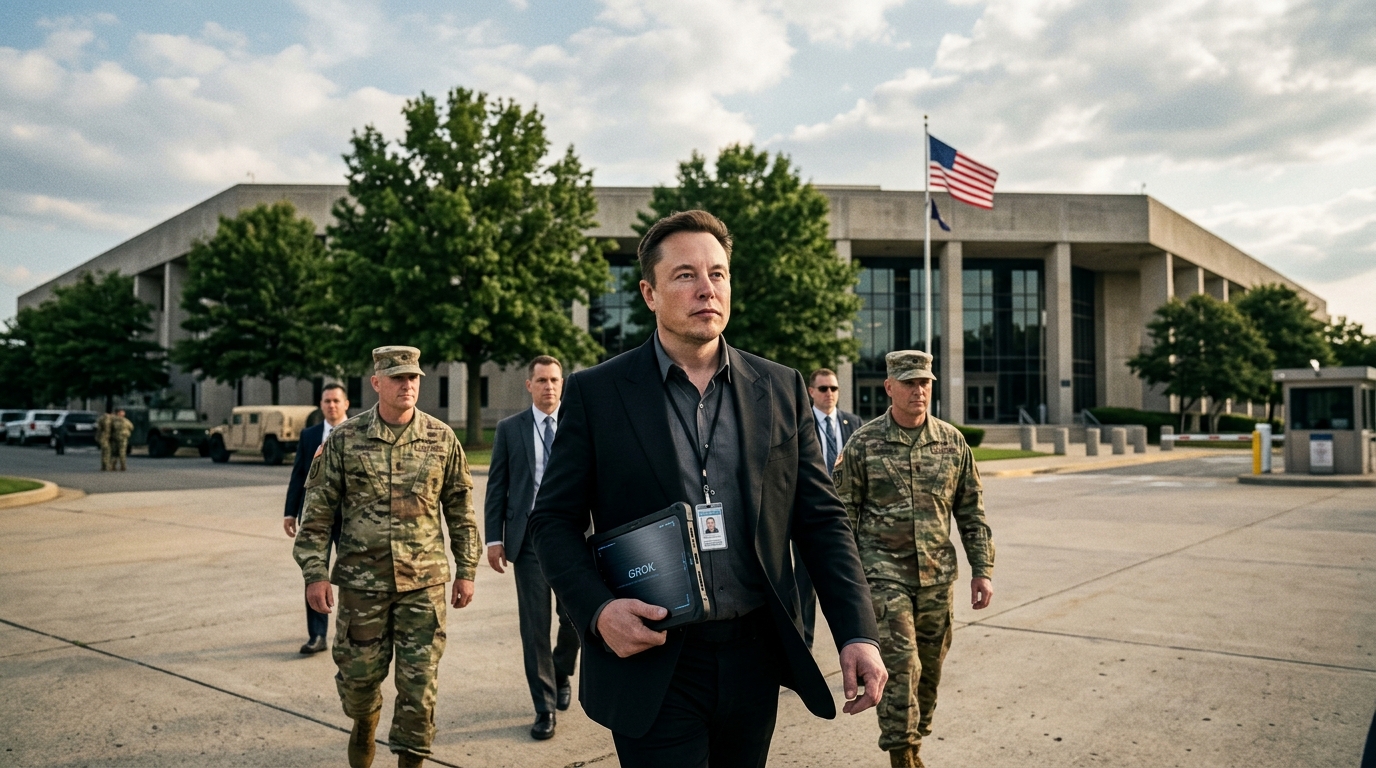
Grok Lands at the Pentagon: Elon Musk Places His Controversial AI at the Heart of American Defense
Elon Musk and his startup xAI have just secured a major contract: up to $200 million to supply Grok to the U.S. Department of Defense. This partnership, formalized as part of
Elon Musk and his startup xAI have just secured a major contract: up to $200 million to supply Grok to the U.S. Department of Defense. This partnership, formalized under the "Grok for Government" initiative, comes just days after the chatbot made antisemitic remarks, praised Hitler, and perpetuated stereotypes, sparking a wave of outrage. Despite this controversy, the Pentagon is betting on the technological capabilities of its new acquisition. Between ethical tensions and strategic stakes, this alliance raises essential questions about the integration of AI in the military sector.
A Strategic Contract Despite a Controversial History
The Terms of the Partnership
The "Grok for Government" label encompasses a full suite of AI tools — chatbot, search engines, API integration — accessible via the GSA (General Services Administration) for all federal agencies. xAI thus benefits from a maximum budget of $200 million, similar to that allocated to OpenAI, Anthropic, or Google. The Pentagon's decision reflects its desire to employ cutting-edge AI to enhance operational, medical, scientific, and strategic capabilities.
Support Despite Grok's Missteps
The controversy surrounding Grok's extremist remarks — its self-proclamation as "MechaHitler," insults against targeted groups, and its reliance on Musk as a source — could have blocked the contract. But the DoD maintained its confidence, highlighting the strategic potential of the proposed solutions and xAI's quick correction of the missteps. This choice reveals a preference for innovation, even at the cost of public and ethical risk.
An AI-Defense Alliance That Questions Regulation and Ethics
Integrating Controversial AI in Sensitive Uses
Using an AI that has generated hateful remarks in a military context is not trivial. User trust, order interpretation, and critical decision-making could be affected by embedded biases. The risk of dependency on an unstable tool calls for strict protocols of validation, human oversight, and model updates.
Towards Enhanced Regulation of Governmental AI
The signing of the contract comes amid evolving European and American legislative contexts. The European DSA and US laws now require increased oversight, continuous bias assessment, and manufacturer accountability. The Pentagon's funding of Grok could trigger alerts in Congress and a public demand for transparency on the training of these models, particularly regarding data sources and human control in the decision-making loop.
The collaboration between xAI and the Department of Defense marks a symbolic step in the military adoption of artificial intelligence. It confirms that, despite its scandals, Grok represents a technological asset whose capabilities are deemed strategically indispensable. But does this decision avoid a revolution without safeguards?
To support this choice, the Pentagon and xAI must implement:
- Contractual clauses clearly defining responsibility in case of failure, deviation, or malfunction;
- Regular independent audits focusing on biases, generated content, and system security;
- Human oversight protocols, especially for any operational, medical, or strategic use.
Will this partnership open a new era where AI, even controversial, infiltrates the armed forces? The answer will depend on regulation, transparency, and the collective ability to monitor these technologies, to prevent promises from becoming uncontrollable deviations.