July 2026 Gemini Drop: Autonomous Slides, Gemini Live on Home Mini, Expanded Memory
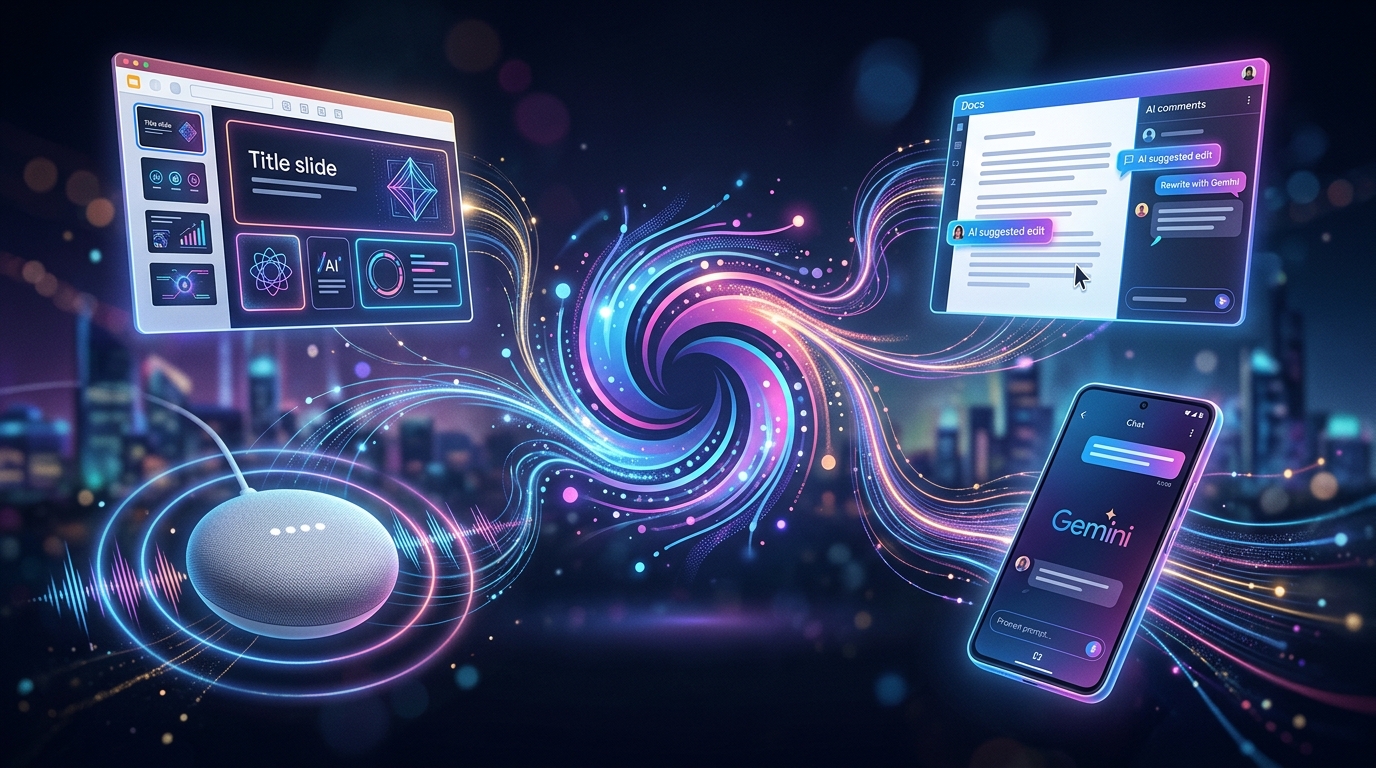
The late July Gemini Drop is one of the densest of the year: full generation of Slides decks with your own style, Gemini Live arrives on old Home Mini and Nest Hub, conversational memory extended to 15 minutes, 11 additional languages in Docs. Overview.
On July 30, 2026, Google released its monthly Workspace Feature Drop, officially known as the July Gemini Drop. Officially, it's a “Workspace update”. In reality, it's a full-scale AI feature reload across the entire Gemini line—from Slides to Google Home, including Docs, Meet, and Vids.
The consolidated list is available here: https://gemini.google/gemini-drops/ — and the official Workspace post: Google Workspace Blog.
1. Slides: Autonomous Deck Generation
This is probably the most impressive feature of the Drop. From Slides, you can now:
- Describe your presentation in natural language (“a 12-slide investor pitch on my B2B platform project”)
- Reference existing decks so that Gemini adopts your layout style, colors, branding
- Let Gemini draw from your Docs, Sheets, PDFs, or old decks to automatically gather content
- Receive a complete deck—text, structure, visuals—in a fraction of the time
This is a step above what existed (“help to make a slide”). Here we’re talking about a complete end-to-end generation that respects your organization’s visual identity.
2. Docs: Actioning Comments and Creating Visuals
Gemini in Docs takes another step in autonomy:
- Summarizing comment threads—useful in long collaborative docs where the discussion thread becomes unreadable
- Creating and responding to comments
- Applying suggestions: Gemini directly proposes edits that address the comment, you approve or reject
- Creating integrated visuals—diagrams, illustration images—directly in the document thread
Adoption bonus: 11 additional languages added to Docs generation—Mandarin, Dutch, Malay, Hebrew, Polish, Turkish, Czech, Indonesian, Swedish, Danish, Norwegian. French was already supported.
3. Vids: More Advanced AI Editing
The Drop mentions improvements to Google Vids (the video editing tool integrated into Workspace) to create more engaging videos with Gemini. Few technical details—but in a context where MiniMax H3 and Seedance 2.5 (Chinese side) and Sora 2 and Veo 3 (American side) compete in video generation, Google discreetly strengthens its enterprise offering.
4. Google Home and Nest: Gemini Live on Older Hardware
Announced a few days earlier on July 23, but consolidated in the July Drop: Gemini Live—the real-time conversational mode—finally arrives on:
- The first-generation Google Home Mini (2017)
- The first-generation Nest Hub
This is a strong signal: Google does not want to fragment its lineup between “AI devices” and “passive devices”. The command “Hey Google, let's chat” triggers the conversational experience on speakers that are seven years old.
Meanwhile, the conversational memory of Gemini for Home extends from a few minutes to 15 minutes for the entire experience. You can have a real multi-step conversation without the assistant forgetting the context.
5. Meet on Android Auto
Anecdotal but handy: Google Meet now works on Android Auto. Join a meeting in the car (audio only, for safety reasons) without handling the phone.
6. Extended Data Regions for the Gemini App
A less visible but crucial aspect for European companies: support for data regions is extended to the Gemini app. Administrators can now choose where their AI data is processed and stored—European Union or United States.
This is a direct response to GDPR requirements and tenders where exclusive EU storage is required. Google aligns with what Microsoft (Azure) and OpenAI (via Microsoft) have offered since 2024.
7. Behind the Scenes: Gemini 3.5 Flash and Gemini Omni
The Drop highlights two models gaining power in the back-end:
- Gemini 3.5 Flash: a faster and cheaper version of Gemini 3.5, positioned for high-frequency use in consumer apps
- Gemini Omni: the unified multimodal model (text, image, audio, video) becoming the default engine for several Gemini surfaces
Note: Gemini 3.5 Pro (the flagship initially planned for July) has been postponed. Alphabet saw $225 billion in market capitalization evaporate following this announcement, and the departure of several key DeepMind talents to OpenAI and Anthropic increases the pressure.
What the Drop Says About Google's Positioning
Three possible interpretations:
- Google executes at a high pace on its products. Slides, Docs, Home, Meet—each surface receives substantial AI improvements every month. The distribution is massive (billions of users), and integration into existing workflows is the real moat.
- Google is lagging on the flagship model. The postponement of Gemini 3.5 Pro and the DeepMind exodus are concerning signals. On the frontier model podium, Google slips behind Anthropic and OpenAI, with China quickly catching up from below.
- Google bets on ubiquity more than peak performance. An LLM 15% less good than the best, but present on 3.5 billion phones and integrated everywhere, may gain more value than a “better” model isolated in an app.
To Watch: The Next Drop
The monthly pace of Gemini Drops is officially established. Every end of the month, a batch of new features arrives. To not miss anything, the consolidated page remains: gemini.google/gemini-drops.
The August Drop will be one to watch: Google hinted that Gemini Spark—the agent that drives Chrome for you, just announced—will be at the heart of the new features. If the deployment lives up to its promises, we will enter a new category of usage.