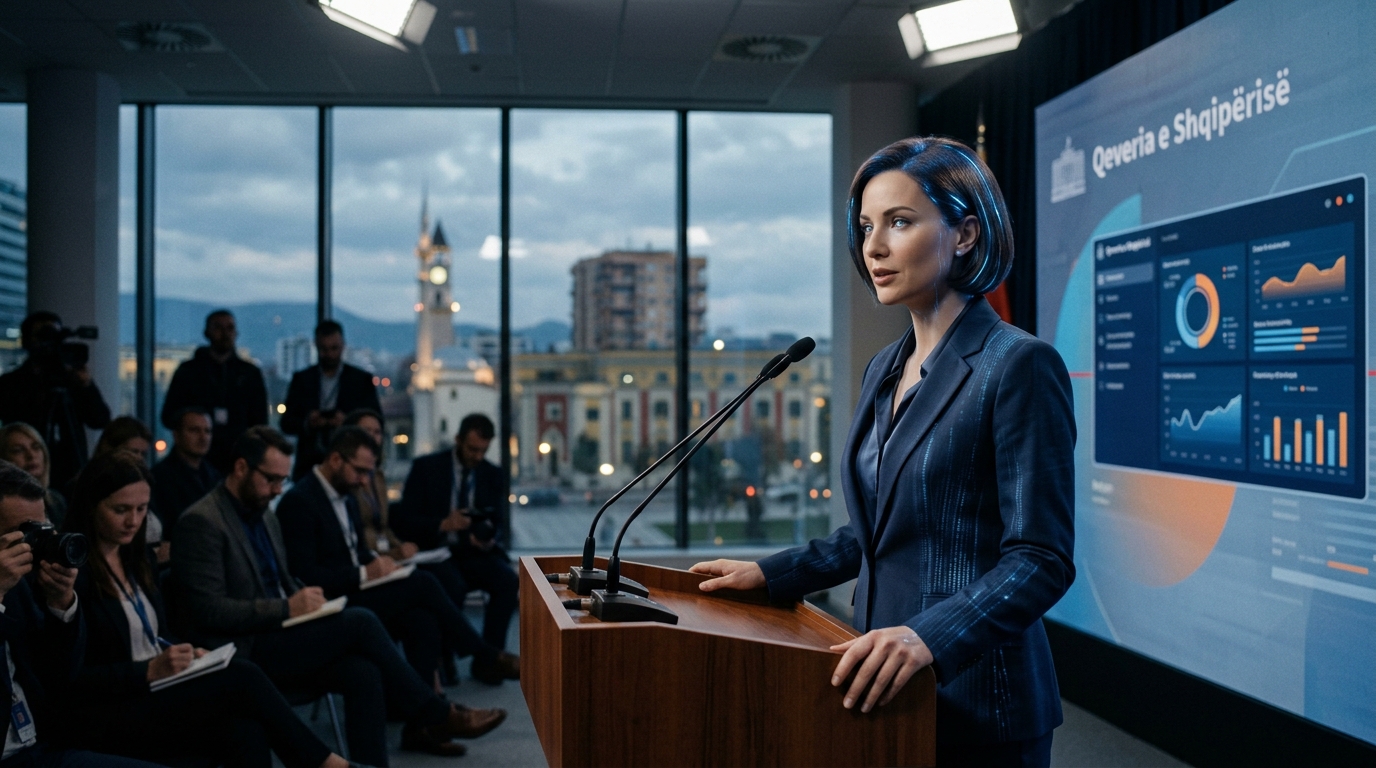
Diella, the World's First 'AI Minister': Albania Takes the Leap
An artificial intelligence at the head of a ministry? This is the unprecedented decision just made by the Albanian government. With the appointment of 'Diella', an AI-powered conversational agent,
An artificial intelligence at the head of a ministry? This is the unprecedented decision just made by the Albanian government. With the appointment of 'Diella', an AI-powered conversational agent, Albania becomes the first country in the world to officially assign ministerial tasks to a machine. A strong symbol – between automation, the fight against corruption, and digital ambition.
What exactly is Diella?
Diella is an artificial intelligence developed by the Albanian state as part of its digital transformation program. Initially, it was designed as a virtual assistant integrated into the e-Albania platform, the local equivalent of online administrative procedures. It allowed citizens to obtain official documents, ask questions about their rights, or track the status of their requests. So far, nothing extraordinary. Many countries are already testing or using AI in their public services.
What changes here is that Diella has been officially designated as a 'minister'. Presented in the form of a female avatar, she now has an identified role in the government organizational chart. Her mission focuses on a highly sensitive issue in the country: the management of public procurement. The government's stated goal is clear. Thanks to her automatic analysis capabilities, Diella should be able to detect irregularities in tenders, issue alerts in case of suspected fraud or corruption, and produce evaluation reports based on objective criteria.
How will this appointment materialize?
Legally, Diella is obviously not a minister in the traditional sense. She does not sit on the Council of Ministers, holds no regulatory power, cannot sign laws, nor answer to Parliament. She is a hybrid figure, both an advanced technological tool and a political symbol of a state that wants to present itself as a pioneer in algorithmic governance.
In practice, Diella will mainly operate through the e-Albania platform interface. Civil servants, companies, and citizens will be able to consult her analyses or opinions on public procurement procedures. Using automated processing, she will be able to scan submitted files, verify their compliance, evaluate offers according to a set of criteria, and produce alerts in case of detected anomalies.
She will not make any final decisions. Her role is limited to providing decision support. In this sense, she acts as an expert tool, or more precisely as an algorithmic filter intended to streamline and secure procedures. Any decision, awarding of contracts, or rejection of files will remain under the exclusive control of human public agents.
The government claims that all her interventions will be traceable, framed by transparent protocols, and regularly audited to prevent risks of bias or misconduct. It remains to be seen whether these guarantees will be enough to reassure public opinion and international partners.
Are there any precedents?
The Albanian initiative seems unprecedented in its form and ambition, but it is part of a broader global trend: the increasing automation of public management by artificial intelligences. The closest case dates back to 2018 in Japan, in the city of Tama, where an AI named Michihito Matsuda ran for a municipal election. Presented as a neutral and rational alternative to the traditional political class, it garnered several thousand votes but was not elected. It was more of a publicity stunt than a real takeover.
In Estonia, one of the most advanced countries in e-government, authorities launched a program called Kratt in 2020, named after a magical servant from local folklore. The goal was to allow every citizen to interact with the administration through an AI. Kratt can already generate standardized administrative responses and perform some simple tasks, but it has no political or institutional role.
In China, AI systems are massively used for human resource management in the public sector, notably to evaluate Party officials' performance. Some municipalities also use AI to detect fraud or allocate social aid. However, these tools remain in the background and are never presented as public agents per se.
In the United Kingdom, the use of AI to allocate social housing has sparked controversy. Allocation errors led to unjustified evictions, reigniting the debate on the limits of automation in social policies. Since then, authorities emphasize the importance of keeping humans in the loop.
Finally, in the United States, several elected officials already use AI as a working tool: to draft speeches, analyze electoral data, or simulate public policies. But again, these are only digital assistants, not official institutional agents.
In summary, no country had yet taken the step of granting an AI a formal ministerial status, even symbolically. Albania is therefore pioneering in more ways than one, even if it means facing numerous criticisms.
An experiment to watch closely
The appointment of Diella raises as much enthusiasm as it does fears. On one hand, it embodies the promise of more efficient, less corrupt, more rational public management. In a country where suspicions of favoritism and embezzlement are recurrent, a neutral AI could bring a real gain in transparency. On the other hand, this initiative questions the meaning of democracy, the place of humans in public decision-making, and the risks of algorithmic opacity.
If Diella fails or produces unforeseen negative effects, she could become an emblematic example of the technocratic pitfalls of AI. But if she manages to demonstrate her usefulness without replacing political decision-making, she could pave the way for other experiments in Europe.
The debate is launched. And this is probably just the beginning.