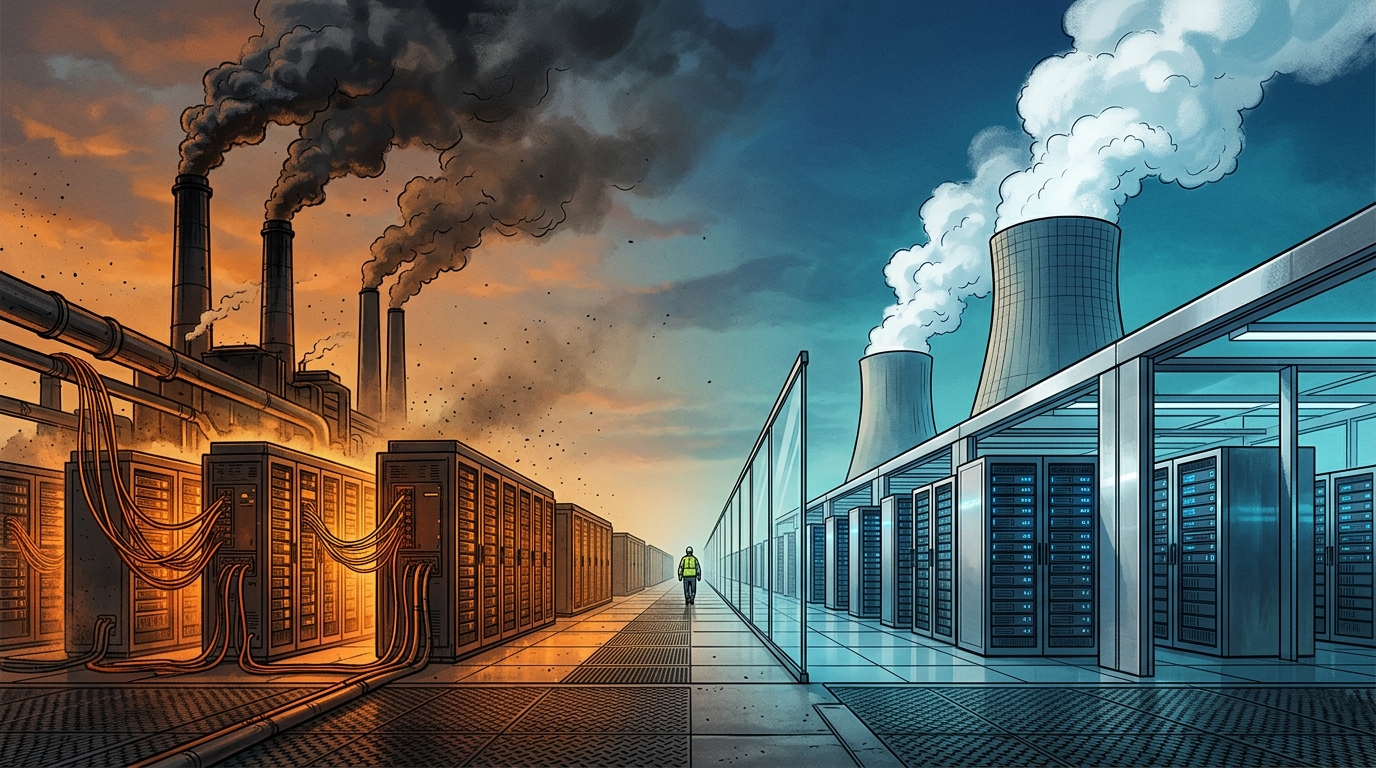
AI Datacenters: Electricity Consumption to Double by 2030, 'Refossilization' Threatens
The report by Omnegy (EPSA) — cited by Libération — predicts that global datacenter consumption will double to nearly 1,000 TWh by 2030. In 2024, 58% of their electricity already came from fossil sources. France can leverage its decarbonized nuclear power, but the overall climate equation is becoming worrisome.
A report from the consulting firm Omnegy, the energy advisory subsidiary of the EPSA group, cited by Libération, sounds the alarm: the global electricity consumption of datacenters is expected to double by 2030 to reach nearly 1,000 TWh. The pace of expansion — driven by the explosion of generative AI needs — puts the global climate trajectory under strain and raises the risk of “refossilization” of the energy mix: a return to coal and gas to handle the load.
The Frightening Numbers
- In 2024, global datacenter electricity consumption reached 415 TWh — equivalent to the entire annual consumption of France.
- By 2030, it is expected to double to ~1,000 TWh, surpassing the total consumption of Japan.
- Consumption of datacenters exclusively dedicated to AI grew by +50% in 2025, and could triple by 2030.
- 58% of the electricity consumed by datacenters in 2024 still came from fossil sources — compared to 42% from decarbonized sources (renewables + nuclear).
Simply put: every interaction with ChatGPT, Gemini, Claude, or Grok has an energy cost — still marginal individually, but multiplied by billions of daily queries.
The Risk of Refossilization
The term is new in climate vocabulary. It refers to the return to fossil energies to meet an electricity demand that renewables and nuclear cannot keep up with in the short term. Specifically:
- The United States is reopening decommissioned coal plants to power AWS, Microsoft, Meta datacenters.
- China is building gas plants next to its AI hubs in Guiyang and Shenzhen.
- The European Union still maintains 190 GW of gas capacity and 100 GW of coal — much more than anticipated five years ago.
A “clean” generative AI is a myth if the electricity powering it is carbon-based. At the current growth rate, no renewable source can keep up.
The French Card: Decarbonized Nuclear
Omnegy — like most serious observers — highlights a structural French advantage. The national electricity mix relies ~70% on nuclear, with a carbon factor of about 50 g CO₂ per kWh, compared to 400-500 g in Germany, 580 g in China, 380 g in the United States. In other words: a datacenter connected to the French grid emits eight times less CO₂ per AI request than the same datacenter in China.
This fact has become a major commercial and political argument:
- France already has more than 350 datacenters in operation.
- Choose France 2026 (June in Versailles): €93 billion in investment commitments, including SoftBank announcing €75 billion to build 5 GW of AI computing capacity in France.
- The ADEME anticipates (January 2026 report) a 3.7-fold increase in digital consumption in France by 2035.
The post-Choose France strategy is clear: capture the datacenter wave by leveraging the nuclear legacy, position as a sovereign hub for European AI, and sell decarbonization as a differentiator.
The Limits of the Nuclear Bet
Three important nuances:
- Connection capacity is finite. EDF and RTE cannot absorb an additional 5 GW at the snap of a finger. The average connection delays in France for a datacenter now exceed 36 months. Some projects are already being postponed.
- The nuclear fleet is aging. The average age of French reactors is ~38 years. The Flamanville EPR started in 2024 after a 12-year delay. The EPR2 program (6 new reactors) will not deliver before 2035-2038.
- Land and water. A hyperscale datacenter takes up 50-100 hectares and consumes millions of cubic meters of water per year for cooling. Prefects and local authorities are starting to refuse them.
What Major Players Are Preparing
The race for “green compute” is pushing towards several technical avenues:
- Small Modular Reactors (SMR) — Microsoft, Google, and Amazon have all signed Power Purchase Agreements with SMR developers (X-energy, TerraPower, Kairos Power).
- Space datacenters — the SpaceX-Nvidia bet (Starmind AI1, launch Q4 2027) relies on orbital solar energy and passive cooling in the vacuum.
- Software optimization — more efficient models (MoE, quantification, distillation), intelligent routing (“effort slider” of ChatGPT and Claude).
- Local and sovereign compute — Qwen 3.8 Max, DeepSeek V4 hosted in Europe via OVHcloud or Scaleway reduce latency and concentrate consumption in decarbonized mixes.
The Nuance
Two points to watch:
- The Omnegy report is solid but not neutral: Omnegy is an energy consulting firm. Its estimates naturally lean towards the demand for energy expertise. The IEA central figures (~945 TWh in 2030) are close — so the range of ~950-1000 TWh is credible, but remains a projection.
- AI consumption is highly concentrated. 80% of the global datacenter load is handled by 10 operators (AWS, Azure, Google Cloud, Meta, Oracle, Alibaba, Tencent, Huawei, TikTok/ByteDance, Baidu). Targeted regulation on these players would significantly change the trajectory — more effective than widespread policies.
What to Watch
Three milestones for France in 2026-2027:
- The concrete deployment of 5 GW SoftBank — how much is actually built vs announced?
- The government's decisions on priority connection thresholds and siting criteria (carbon impact, water, land).
- The outcome of the standoff with local authorities who are beginning to refuse projects — Marseille, Lyon, several prefectures have hardened their positions.
One thing is clear: “digital sobriety” is becoming a real political debate, not just an associative slogan. And the energy question will weigh as much on the geopolitics of AI as Nvidia chips or open-source models. The decisions made in the next 24 months — on the energy mix, siting authorizations, datacenter carbon regulation — will determine who dominates AI in 2030. France has the cards; it remains to be seen if it plays them.