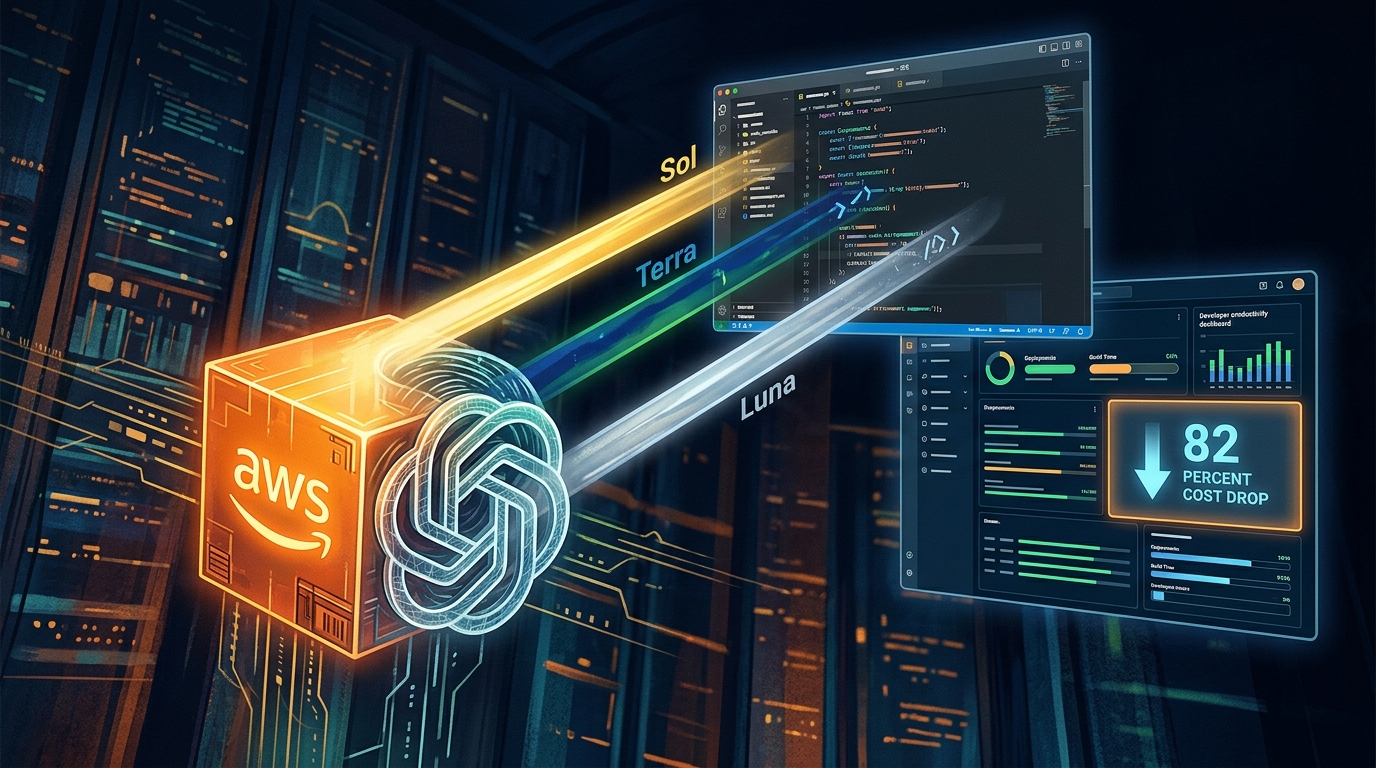
AWS integrates GPT-5.6 into Kiro: the dev-AI war intensifies
Amazon Web Services adds OpenAI's Sol, Terra, and Luna models into Kiro, its spec-based development environment. An 82% drop in cost per completed task on Terminal-Bench 2.1. Analysis of an integration that brings AWS closer to OpenAI and challenges Cursor.
On August 24, 2026, Amazon Web Services announced the official integration of the GPT-5.6 model family — Sol, Terra, and Luna — into Kiro, its spec-based development environment. This marks OpenAI's official entry into the AWS dev stack at a time when the market for AI coding tools is consolidating around two or three major players.
What Kiro is
Kiro is AWS's answer to “prompt-and-iterate” AI tools — Cursor, Windsurf, Continue.dev. Its uniqueness: instead of coding from a simple prompt, Kiro first converts high-level intent into three structured artifacts:
- A requirements document
- A technical design
- A list of executable tasks
The AI model works on these artifacts — not the raw prompt. The result: less wandering, more traceability, better code quality.
What changes with the arrival of GPT-5.6
Before this integration, Kiro mainly ran on Anthropic models (Claude Sonnet 5) and internal AWS models (Titan derivatives). The addition of the three GPT-5.6 models allows developers to choose:
- Sol for complex tasks requiring maximum reasoning ($5/$30 per M tokens)
- Terra for performance/cost balance ($2.50/$15)
- Luna for high-frequency workflows at lower cost ($1/$6)
The integration covers the entire Kiro workflow: spec conversion, multi-step execution, human review checkpoints, property-based testing.
The announced performance
Joint OpenAI × AWS tests on Terminal-Bench 2.1 — a demanding code agent benchmark — show:
- A cost reduction per completed task of about 82% compared to previous configurations
- An increased completion rate on structured workflows
A figure to take with caution: it's a benchmark prepared by the two interested parties, on an evaluation they co-designed. To be reproduced independently.
AWS and OpenAI's strategy
This integration reveals a two-way movement:
- OpenAI diversifies its distribution. Historically heavily dependent on Azure (Microsoft), the company is multiplying channels: ChatGPT desktop, App Store, API, and now AWS Kiro. It's strategically sound as it approaches its IPO.
- AWS responds to Copilot. GitHub Copilot (Microsoft/OpenAI initially, now also Anthropic) captures the bulk of the enterprise dev market. AWS needs a credible response to avoid losing its developer clients. Kiro equipped with GPT-5.6 becomes a real competitor.
- Cursor loses a differentiator. Cursor had become the standard for indie devs and startups. Its advantage: simultaneous access to the best models. AWS Kiro now offers the same, with AWS's enterprise infrastructure behind it.
The competitive landscape of dev-AI
The market is crystallizing around a few configurations:
- GitHub Copilot (Microsoft) — historical dominance, backend Anthropic + OpenAI
- Cursor — the preferred AI-native IDE for indie devs, acquired by SpaceX for $60 billion in June
- Devin (Cognition Labs) — autonomous agent, targets power users (see Ryan Carson article)
- AWS Kiro — new enterprise-cloud offering with a spec-driven approach
- JetBrains AI Assistant — for the JetBrains installed base developers
- Local models (Ollama + Qwen 3.8, DeepSeek V4) — the sovereignty path
The battle is less about the underlying model and more about the developer experience and integration with the existing cloud stack.
What could penalize Kiro
Three obstacles:
- The Cursor ecosystem is far ahead. Extensions, community, tutorials, culture of shared prompts — it's hard to catch up.
- The spec-driven approach requires discipline. It works for mature teams, less so for the rapid prototyping that dominates startups.
- AWS complexity. Kiro is integrated into the AWS ecosystem (IAM, S3, CloudWatch…). Great for those already there, discouraging for those who aren't.
The nuance
Two things to watch:
- The 82% cost reduction figure is marketing. It corresponds to a specific use case (Terminal-Bench 2.1) and a model choice (probably Luna vs Sol). Do not generalize.
- The shift from Anthropic to OpenAI on the AWS side is not exclusive. Claude remains available in Kiro. It's an opening, not a replacement.
What to watch
Three milestones:
- Cursor's response. Since its acquisition by SpaceX, Cursor has unlimited resources. An aggressive enterprise pivot is likely.
- The Anthropic-AWS announcement of strengthening Claude in Kiro to avoid losing ground.
- Independent third-party benchmarks (LiveCodeBench, SWE-Bench Verified) on GPT-5.6-in-Kiro vs GPT-5.6-in-Cursor vs GPT-5.6-in-Copilot.
The dev-AI market is not yet stabilized. In the short term, each major cloud will have its own integrated AI-dev stack. In the medium term, one or two players will consolidate everything. AWS Kiro has just made its move to be in the final pack.