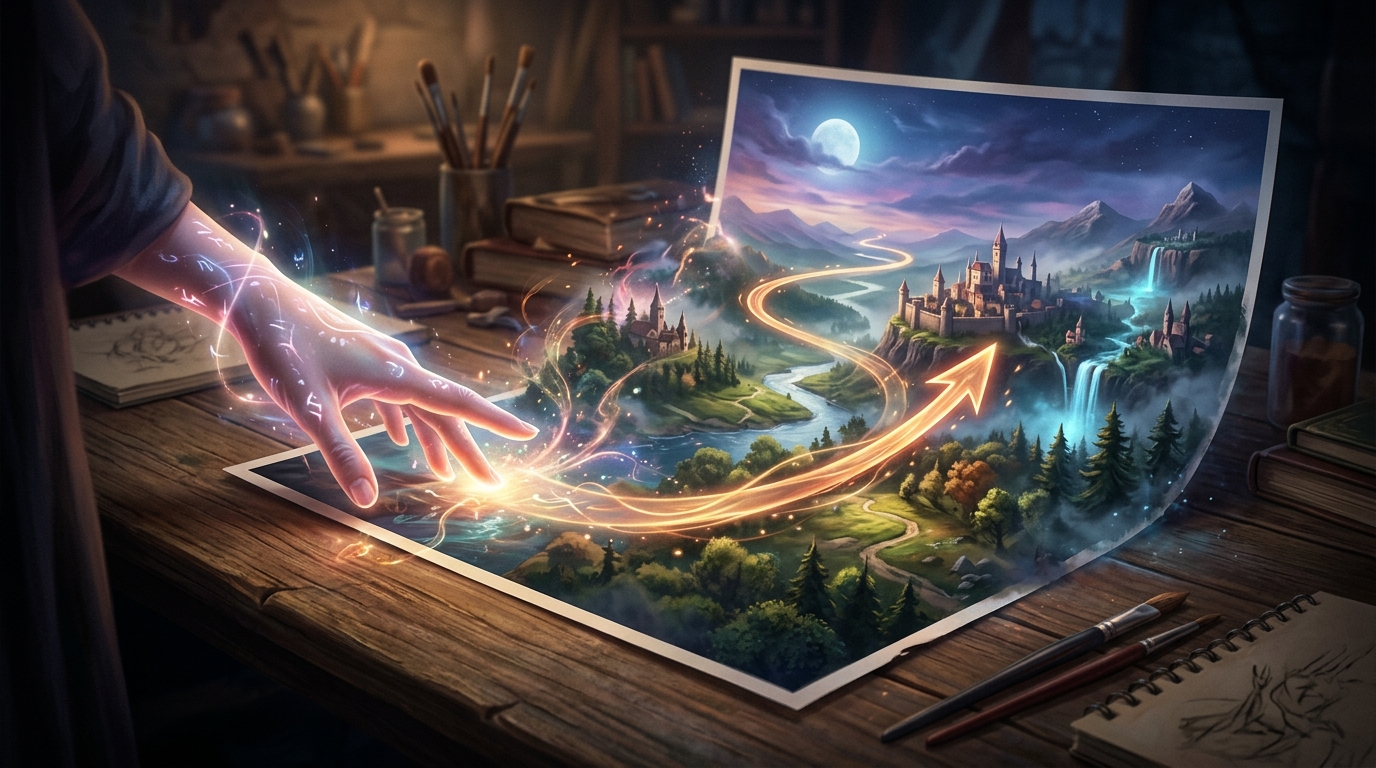
Wonder: Adobe Transforms an Image into a Real-Time Navigable 3D World
Adobe Research and Johns Hopkins release Wonder, a video generation model that transforms a static photo into a real-time explorable 3D environment at 16 fps. An analysis of a shift for games, training, and virtual real estate.
At the end of July 2026, a joint team from Adobe Research and Johns Hopkins University released Wonder, a video world model that shifts categories: from a single static image or short video, the model generates a persistent and navigable 3D world in real-time, at 16 frames per second, controllable by camera movements in six degrees of freedom.
In other words: you provide a photo of your living room, and you get a 3D environment where you can move, turn, go up, and down — as if you were exploring a AAA video game. In real-time.
How Wonder Changes Compared to Previous World Models
Previous video generative models (Sora, Veo, Kling, Runway) produce fixed clips: they decide the camera movement for you and have no real memory of the space. If you return to a starting point, the scene changes. Wonder solves two structural problems:
- Dense camera control: a pixel-space coordinate field with a 3D scaffold and a spherical environment map converts any camera trajectory into frame-aligned visual evidence. Result: the camera truly does what you ask.
- Long-horizon memory with constant latency: full-fidelity history KV caches + sparse attention that selects relevant entries. Scene coherence holds for minutes, not just a few seconds.
The paper Wonder: Video World Model Done Better details the architecture (Jiacong Xu, Hanwen Jiang, Zhixin Shu, Kalyan Sunkavalli, Vishal M. Patel).
It's the first video world model that accepts both image AND video as input, with true real-time navigation in six axes.
Applications That Will Disrupt Several Markets
The commercial potential of Wonder is immediate in at least five segments:
- Independent video games: generate settings from a photo mood board. The production cost of a 3D environment plummets for indie studios.
- Virtual real estate: a single photo of an apartment is enough to create an immersive navigable tour. Goodbye to 3D architectural renderings billed at 500-2000 €.
- Training & simulation: recreate an industrial, medical, or military environment from field images, without LIDAR sensors or scans.
- E-commerce: present a product in its simulated context.
- Cinema and advertising: instant previsualization of shots, sets, and camera movements.
What Adobe Is Doing with This Research
Adobe has an obvious commercial interest: integrating Wonder into Substance 3D, After Effects, Premiere Pro, or creating a new tool in the Firefly Video line. For now, only the research publication is public — no product announced. But Adobe's usual timeline (6-12 months between paper and feature) suggests an integration by early 2027.
Concurrently: Adobe regains control over a segment (world models) that seemed to escape its 2D dominance. Direct competitors — Runway, Pika, Luma — have no equivalent component.
The Nuance
Wonder impresses but remains in academic preview. Public demos run on relatively constrained scenes (interiors, structured urban environments). Extension to ultra-complex environments (crowds, fluids, dense vegetation) is not demonstrated. And most importantly: 16 fps in real-time requires serious GPU power. No mobile or lightweight edge version yet.
What to Watch For
Three milestones in the next 6 months:
- The Adobe MAX 2026 (October): official product integration?
- An open-source replica — the Hugging Face community generally reproduces such papers in 60-90 days.
- The shift of game studios — which first AAA titles will display "environments generated by Wonder" in their credits?
Adobe just reminded us that between research papers and market-moving products, there's a direct line — when you know how to pull it.